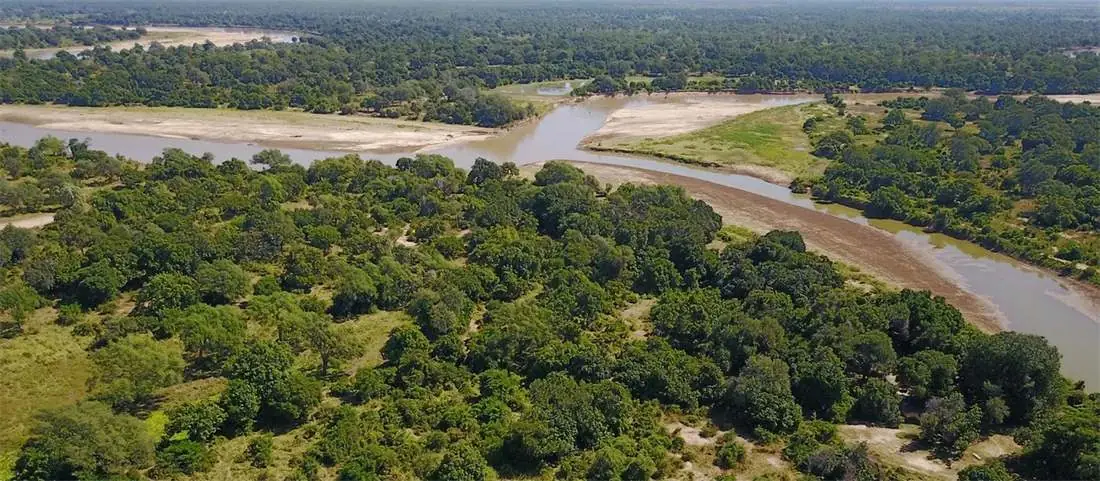
For the first time in decades, both ends of Norman Carr’s original walking safari circuit are in the care of one family. Chibembe, on the east bank of the Luangwa, where guests crossed the river and set out on foot, and Lion Camp, on the west bank, where that first walking circuit led, belong once again to the same story. The circuit is whole again.
This is the story of how that ground came to matter, how it drifted apart, and why the ten camps of the Safari Heritage Collection now carry it forward together.
A pontoon, a camp and a set of viewing tracks
The record begins in 1955. That year a Luangwa Valley Development Unit, under the command of Ranger W. E. Poles, built a seasonal pontoon crossing across the Luangwa at Chibembe to give access from the east. On the far bank it built Lion Camp and a set of viewing tracks: infrastructure made, explicitly, for looking at wildlife.
Lion Camp had begun as a camp for game scouts on anti-poaching patrol, and it was the first camp built west of the Luangwa. Six years later, in 1961, the valley’s official history records the step that changed African travel:
“Lion camp leased to ‘Luangwa Safaris’, a director of this company was N.J. Carr; from this camp Wilderness Trails were pioneered by Carr as a type of tourism.”
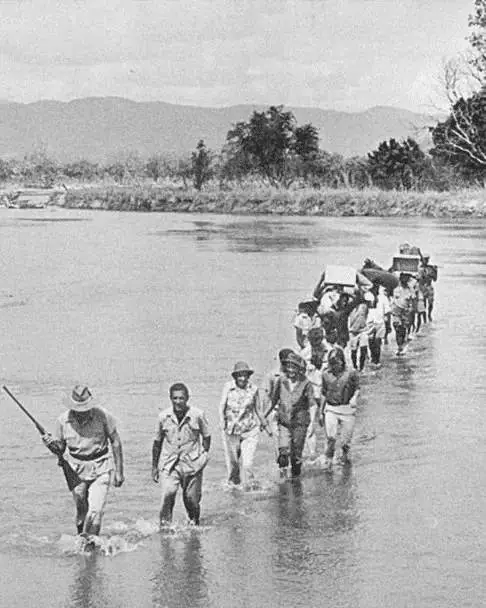
Guests came in from the east, crossed at Chibembe and walked to Lion Camp with Carr. It was the beginning of the walking safari as a new form of tourism, on a corridor of river country about nine miles long.
The camp that trained a generation
In 1968 Carr built a new camp in the area that had always been known as Chibembe, and named it for the place. It became the hub of his walking circuit and the place where a generation of Luangwa guides learned their craft. Phil Berry was among them.
Berry, a former chief ranger, went on to found Kuyenda in the south of the park in 1992, in what he considered some of the finest walking country in the Luangwa. Kuyenda means “to walk” in Nyanja.
Decades apart
In the years that followed, the circuit broke apart. The places along it passed through different hands, and the original ground on the east bank sat quiet. The walking safari spread across Africa, but the corridor where it began was no longer run as one journey.
Putting it back together
The Safari Heritage Collection is Houston family owned, led by Brooke and Corby Robertson, whose ties to the Luangwa Valley go back to 1984. The work of reassembling the circuit began with The Bushcamp Company, the largest operator in South Luangwa, and with Chibembe, acquired from Wilderness Trails Limited, the company Norman Carr formed in 1975 to run his walking safaris.
Chibembe Wildlife Reserve, about 3,500 unfenced acres at the confluence of the Luangwa and the Chibembe Channel, was rebuilt and reopened in June 2026 with walking once again at its heart. Lion Camp, the far end of Carr’s first circuit, is now part of the Collection too.
The camps on both banks of the original corridor, in one family’s hands for the first time in decades.
Ten camps, one continuous circuit
Today the Collection runs as a continuous circuit through the heart of South Luangwa: sixty miles, camp to camp.
- Mfuwe Lodge and The Villas at KuKaya, the gateway, inside the park near Mfuwe. At Mfuwe Lodge, elephant families walk through the reception each year to reach the wild mangoes.
- Six small bushcamps in an exclusive 140,000-acre area in the south: Kuyenda, Chamilandu, Chindeni, Bilimungwe, Kapamba and Zungulila, where walking is the morning rhythm.
- Lion Camp, on the Lion Plain in the remote northern sector, where Carr’s first circuit led.
- Chibembe Wildlife Reserve, on the east bank, where it began, opened to one party at a time by arrangement.
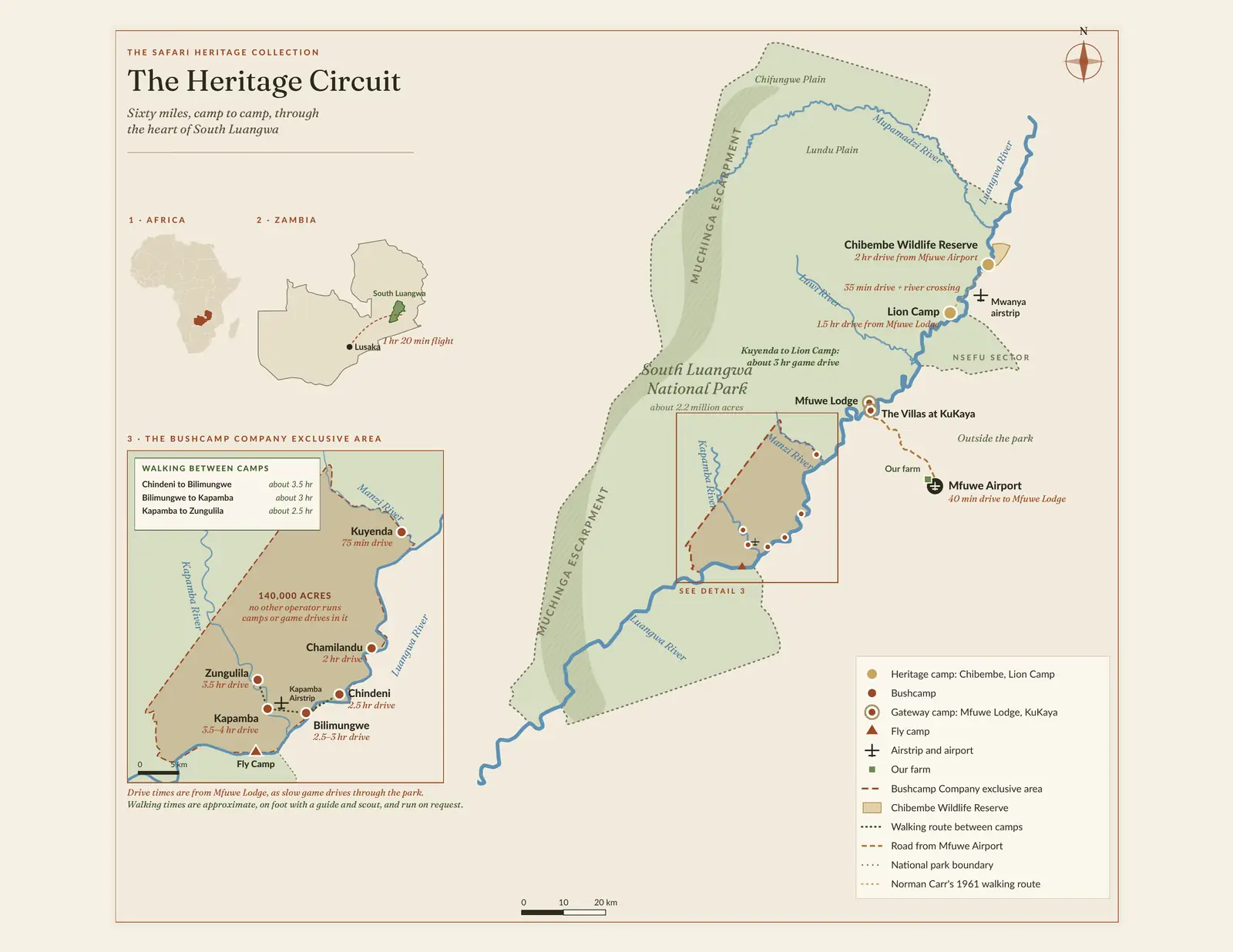
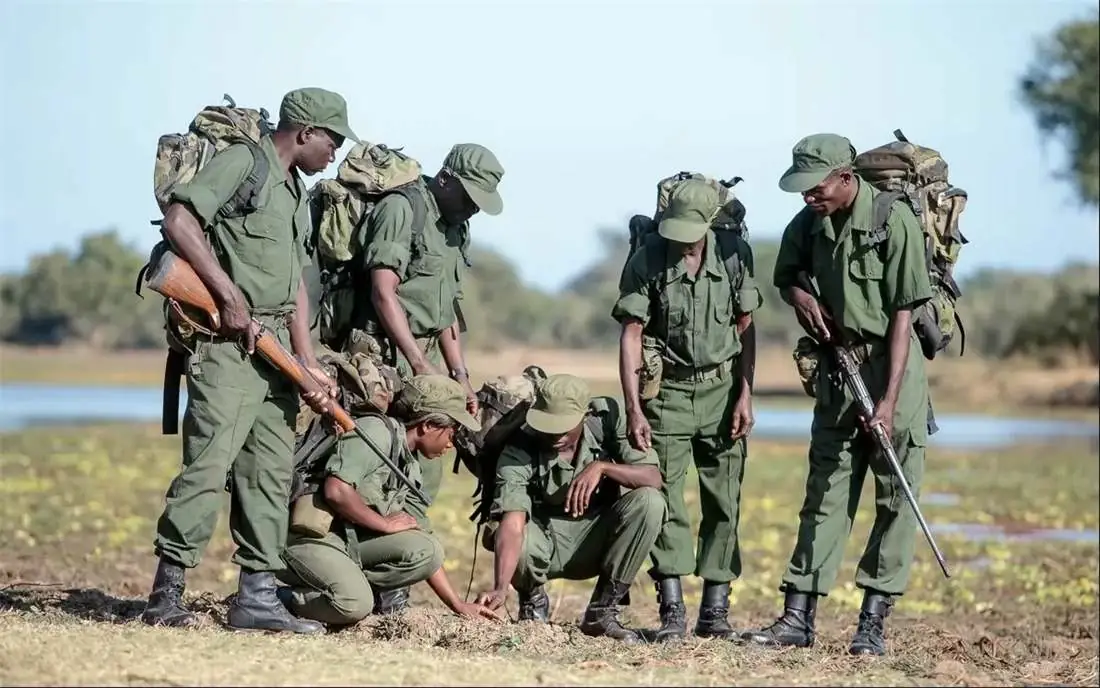
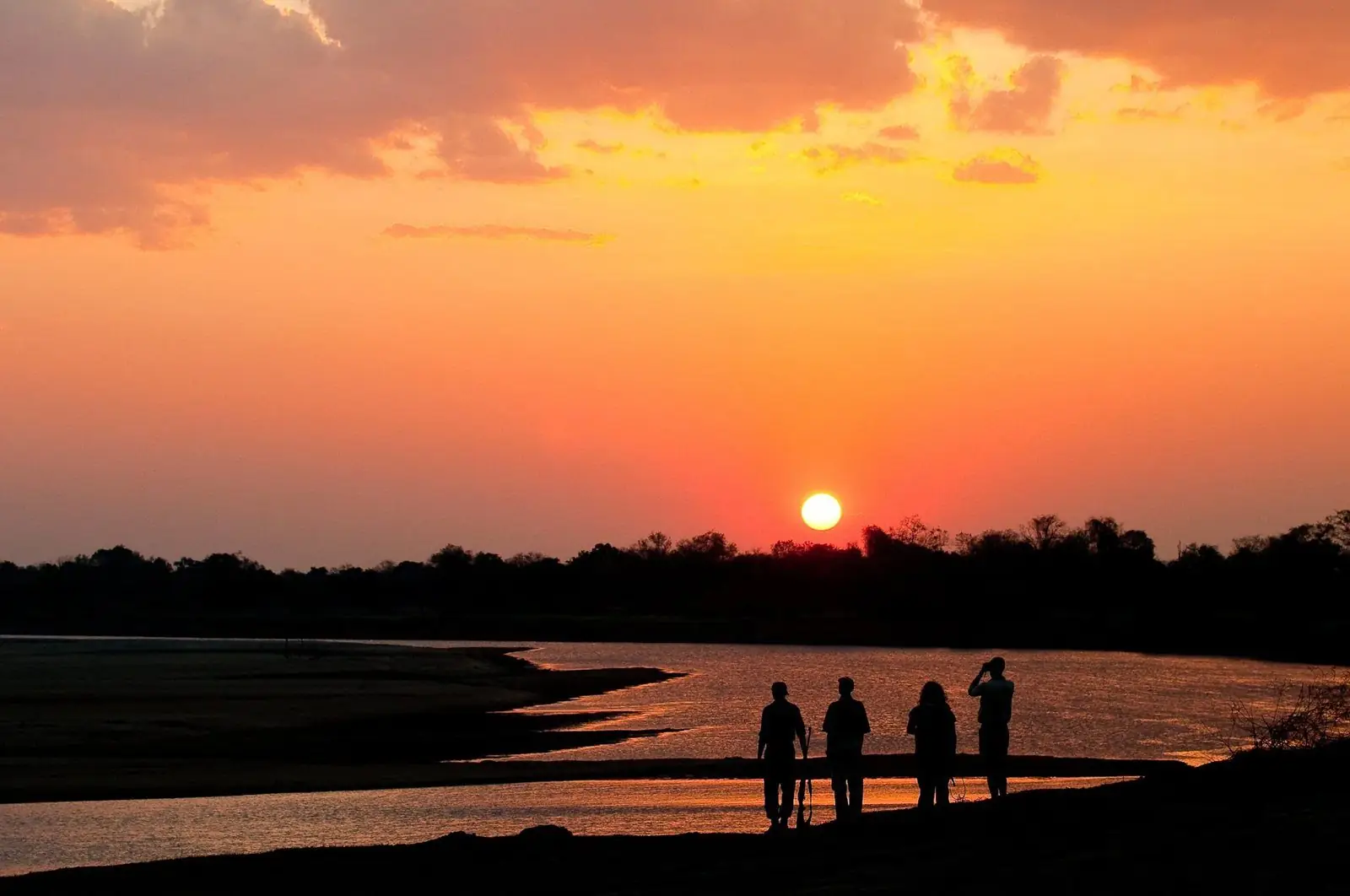
All ten camps offer walking safaris, always with a licensed guide and an armed scout from the Department of National Parks and Wildlife. Walking is always optional: game drives, by day and into the night, run at every camp. But for guests who want it, it is possible to walk where the walking safari began, then travel the whole valley it grew into.
Custodians of a story
A heritage like this is not something a family owns so much as looks after. The camps carry it in the guides they train, the ground they know and the communities they support, through The Bushcamp Company’s Charity Begins at Home and the Zambia Wildlife & Community Foundation. Read how the circuit funds conservation in the valley.
Come and walk where it all began.
Explore the circuitSOURCES: W. L. Astle, A History of Wildlife Conservation and Management in the mid-Luangwa Valley, Zambia (British Empire & Commonwealth Museum, 1999), entries for 1955 and 1961. Camp details as of October 2026.