From 245-million-year-old fossils to million-year-old stone tools, the Luangwa Valley preserves an extraordinary record of animals, people and a river that has shaped them both.
Stand on the bank of the Luangwa River at dusk and everything looks permanent. Hippos surface in the current. A Nile crocodile lies motionless on a sandbar. A leopard waits in the ebony for the light to go, elephants come down to drink, and a fish eagle calls from the top of a dead tree.
None of it is permanent. Every animal in that scene is the latest chapter of a lineage that began millions of years ago, often somewhere else, and every one of them arrived in a valley that was already ancient. This is the story of how the Luangwa was assembled, told with the best dates science can currently give us.
A note on those dates. Knowing when a species evolved is very different from knowing when it first walked into this particular valley, and for most Luangwa animals the second date simply isn’t known. Where the science is specific to the Luangwa, we say so. Where it isn’t, we give the best-supported estimate for when a lineage appeared in Africa, and we say that too.
At a glance: the animals came first
Two short tables tell the whole story. The first shows when each of today’s animals took its modern form, and what the Luangwa’s own fossil record shows. The second follows people in the valley, from the first toolmakers to the farming villages whose way of life is still recognizable today.
| Animal | Today’s form appears in Africa | In the Luangwa’s own record |
|---|---|---|
| Hippo | Hippos by about 16 million years ago | Fossils in riverbank deposits, most within the last ~770,000 years 40 |
| Elephant | African elephant genus 7–5 million years ago; savanna elephant at least 1.9 million years ago | Fossils in riverbank deposits, most within the last ~770,000 years 40 |
| Nile crocodile | Genus Crocodylus about 16 million years ago; Nile crocodile later | Fossils in riverbank deposits, most within the last ~770,000 years 40 |
| Greater kudu | About 2 million years ago | Fossils in riverbank deposits, most within the last ~770,000 years 40 |
| Giraffe | Genus Giraffa at least 9 million years ago; Thornicroft’s is unique to this valley | Fossils of giraffe relatives in the valley 40 |
| Zebra | Today’s plains zebras spread from the Zambia–Botswana region about 370,000 years ago | Fossils in riverbank deposits 40 |
| Buffalo | Today’s southern buffalo about 150,000 years ago | Fossils in riverbank deposits 40 |
| Painted dog | Modern painted dog within the last ~770,000 years | Fossils of wild canids in the valley 40 |
| Lion, leopard, spotted hyena | About 2 million years ago | Not yet found in the valley’s fossils, though they almost certainly lived here |
| People: earlier human species | Toolmakers across Africa from well over 2 million years ago | Stone tools at Manzi, possibly up to about 1 million years old 39 |
| People: our own species | Homo sapiens about 300,000 years ago | Middle Stone Age layers in the valley about 78,000–40,000 years ago 39,40 |
The valley’s fossils show elephants, hippos, crocodiles, buffalo, kudu, zebra and giraffe relatives living here through the last several hundred thousand years, almost all indistinguishable from the animals you see today 40. Our own species appears in the valley’s record only around 78,000 years ago. Early toolmakers may have passed through much earlier, but by the time modern people made the Luangwa home, its wildlife had been here for a very long time. The fossils cannot be dated precisely, because the river washed them out of older deposits, so the dates above are the best science can currently offer.
| When | People in the Luangwa |
|---|---|
| Up to ~1 million years ago | The first toolmakers, an earlier human species, leave simple stone tools at Manzi 39 |
| ~300,000 years ago | Our own species, Homo sapiens, appears in Africa. In Zambia, the Broken Hill skull dates to about 299,000 years ago 43 |
| ~78,000–40,000 years ago | Middle Stone Age people make carefully shaped tools in the valley 39,40 |
| ~37,000 years ago | Hunter-gatherers at Kalemba, just east of the valley, begin a record of fine stone blades, bone tools and beads 45 |
| AD 400–700 | The first farming village in the valley, at Chowo: crops, iron, pottery and settled homes 47 |
| 11th–12th century AD | The Luangwa pottery tradition spreads across northern and eastern Zambia 48 |
| Today | Villages around the park still plant with the rains, fish the river as it rises and falls, and share their land with elephants |
For some 1,600 years, since the first farming villages, the basic shape of village life in the valley has held: fields planted when the rains come, iron tools, pottery, fish from the river, and a daily life lived alongside the wildlife. Much else has changed, from languages and chiefdoms to colonial rule, schools and roads. But the rhythm of the river has stayed the same.
I. The Valley Comes First
Rifting begins in the early Permian, roughly 299–273 million years ago
The Luangwa Valley is a rift. Beneath the floodplain lie two opposing fault-bounded basins holding up to 8,000 meters of Permian and Triassic sediment, and geologists who mapped them with seismic surveys concluded that rifting began in the early Permian 1. The trough is usually described as an arm of the East African Rift system 2, but its foundations were laid when Africa was still part of the supercontinent Gondwana, long before the dinosaurs.
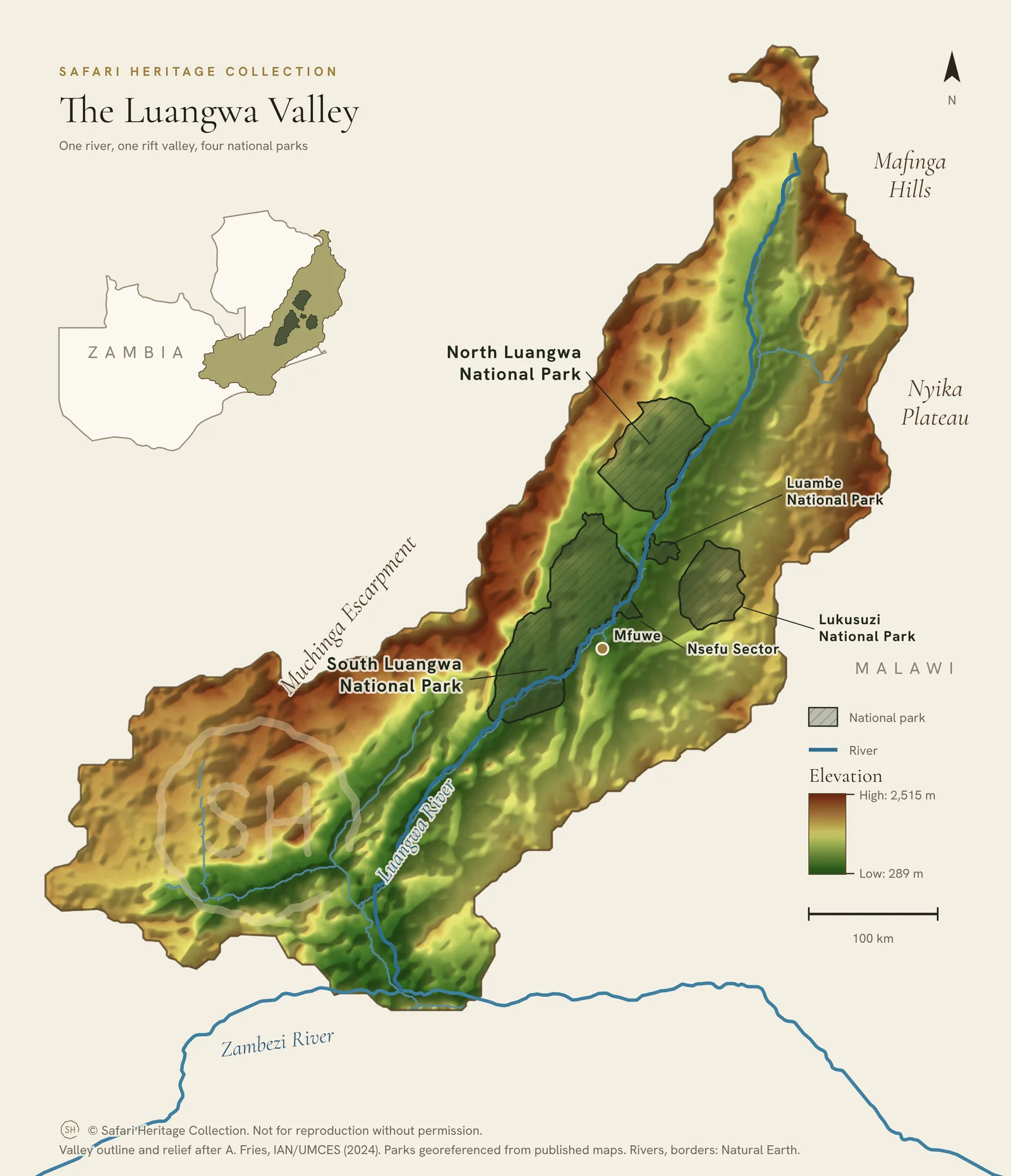
Those old rocks are not empty. Near Sitwe in the upper valley, the roughly 245-million-year-old Ntawere Formation is one of Africa’s richest Triassic fossil beds. It has yielded Luangwa drysdalli, a mammal forerunner named for the valley itself; Lutungutali sitwensis, a close relative of the earliest dinosaurs; giant amphibians; and a large reptile from the crocodile side of the family tree 3,4.
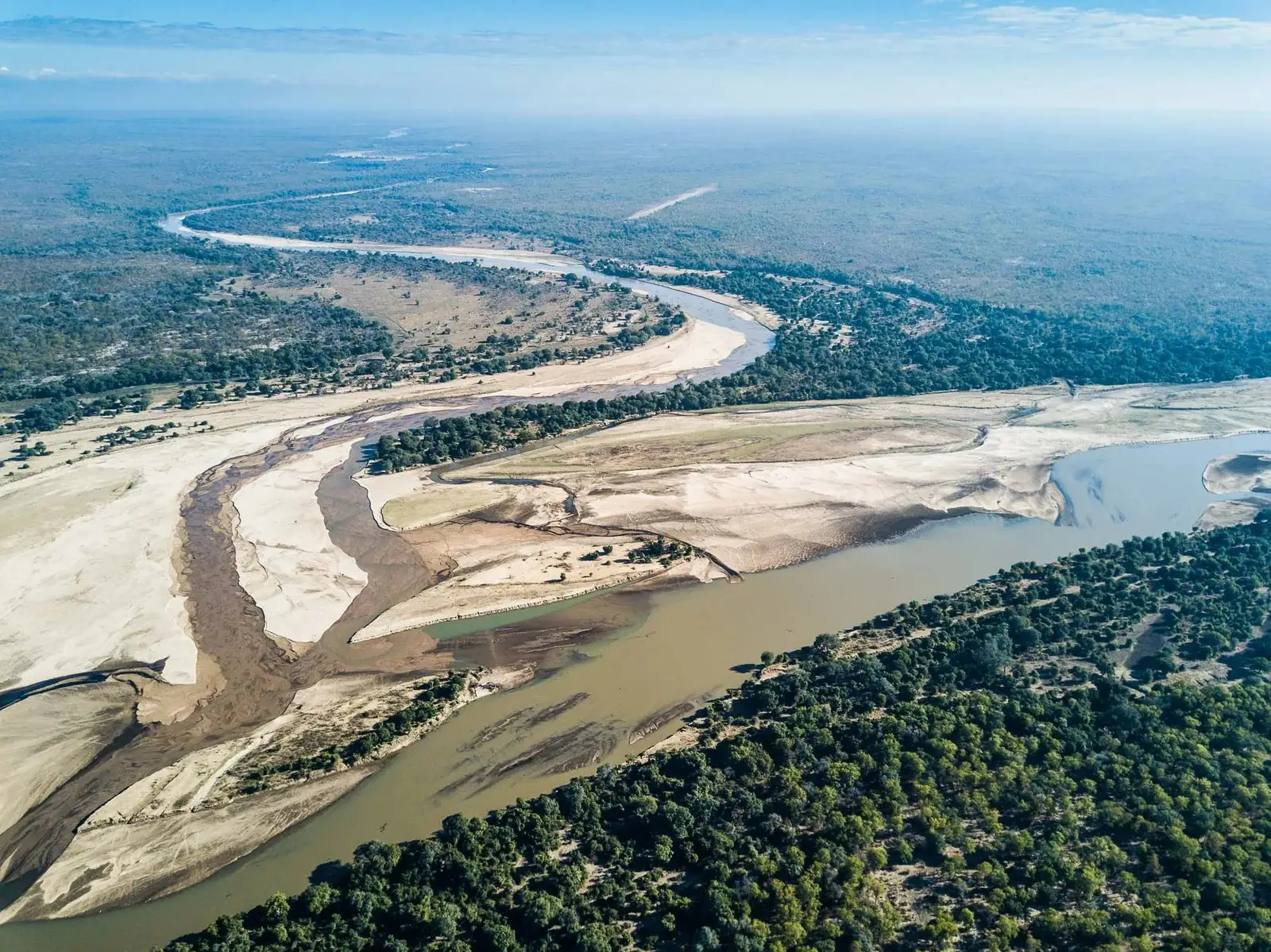
The modern valley floor is far younger, a cap of river sediments laid over the old rift fill 2. Across it the Luangwa did what it still does: meandering, cutting new channels, abandoning old ones as oxbow lagoons and spreading fertile silt. Its reliable water likely made the valley a refuge during Africa’s long dry spells, and a natural corridor between the central plateau and the Rift Valley 2. The stage was built. Then it filled.
II. The Making of Luangwa’s Wildlife
Each of the animals below took shape by a different road. What follows is where each lineage came from and when it took its modern form.
Nile crocodile Crocodylus niloticus
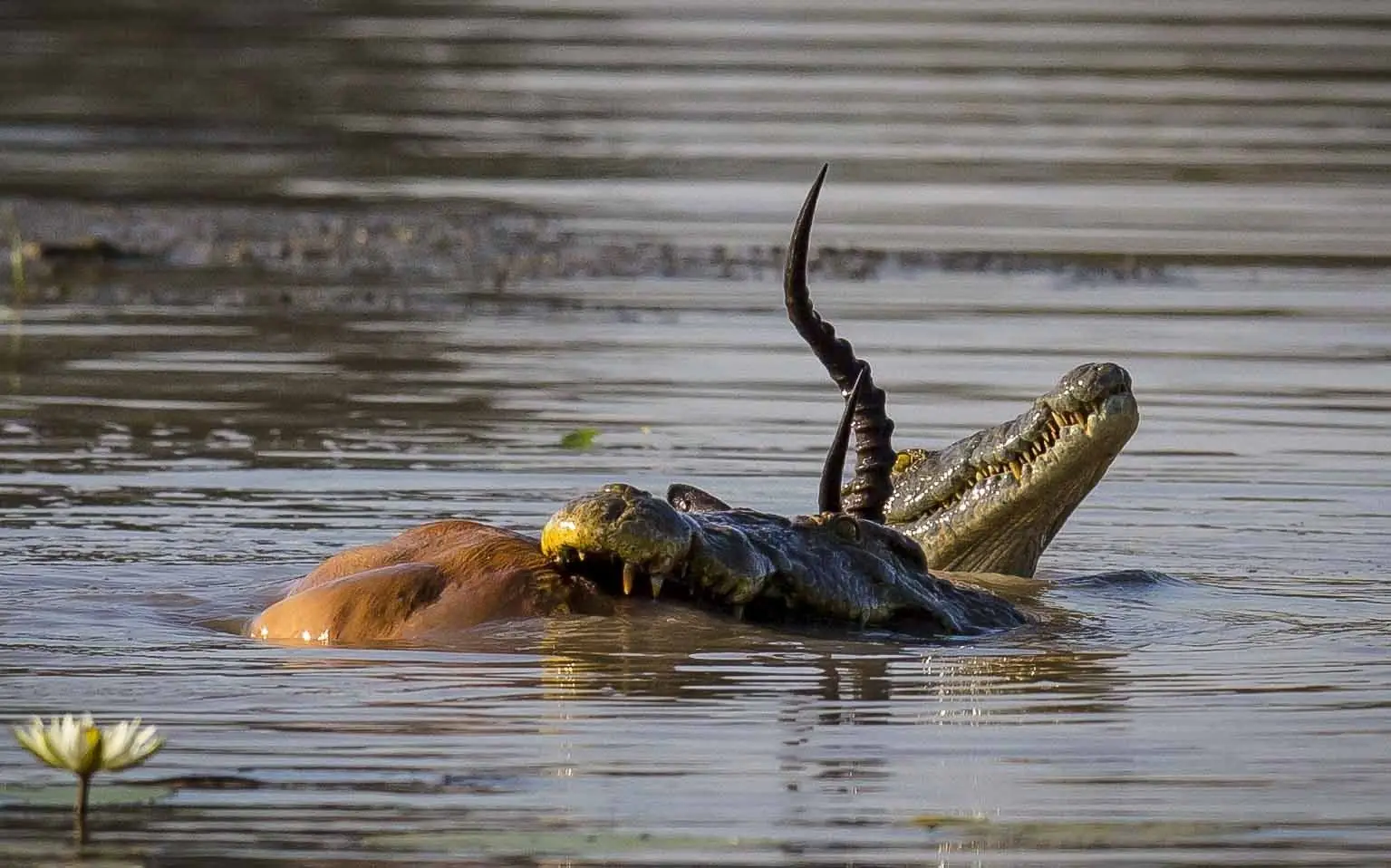
Crocodile-line reptiles: more than 200 million years ago · Genus Crocodylus: Miocene, about 16 million years ago
It is tempting to say the Luangwa’s crocodiles have been here since the dinosaurs. The crocodile branch of reptiles really is that old, and its members lived in this basin in the Triassic 3. But the genus Crocodylus appeared much later, in the Miocene. A 2021 genetic study places its origin in Africa about 16 million years ago 5; an earlier study argued for the Indo-Pacific and a later date 6. The oldest fossils of the Nile crocodile itself are younger still 7. The animal on the sandbar is a relatively recent species carrying a body plan more than 200 million years in the refining.
Common hippopotamus Hippopotamus amphibius
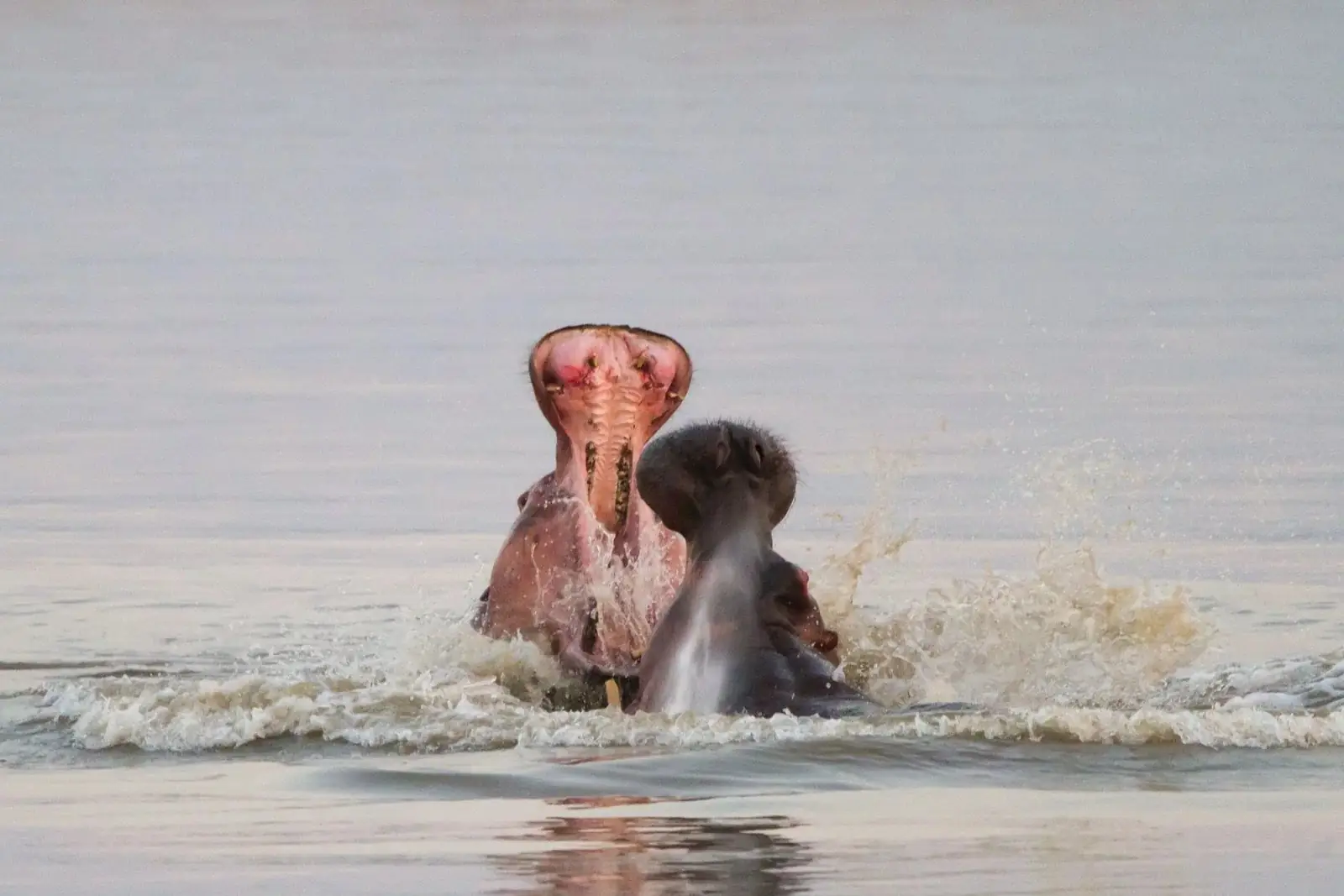
Split from the whale lineage: more than 50 million years ago · First hippos: East Africa, by about 16 million years ago
The hippo’s closest living relatives are not pigs but whales and dolphins, and the hippo branch descends from the extinct anthracotheres 8. The first true hippos appear in East Africa in the Miocene: Kenyapotamus by about 16 million years ago 9, and some researchers argue that still older Kenyan and Ugandan fossils belong to the family too 10. In the Luangwa, hippos are engineers, crowding the river by day and walking inland at night to graze, carrying nutrients from land back into the water.
African savanna elephant Loxodonta africana
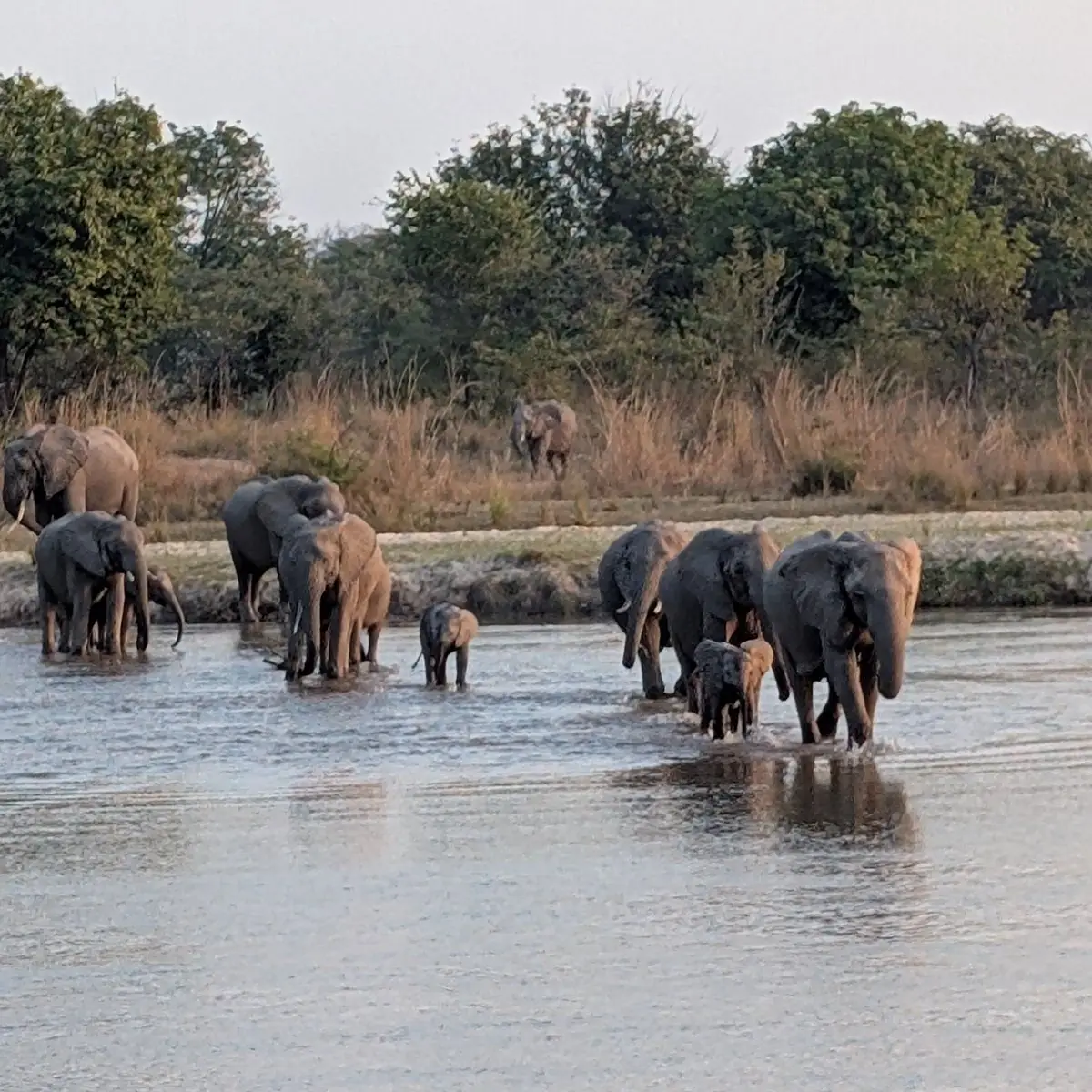
Elephant order: about 60 million years ago · Genus Loxodonta: 7–5 million years ago · Savanna and forest elephants split: at least 1.9 million years ago
Elephants are the last survivors of an African order that began about 60 million years ago with Eritherium, a trunkless animal the size of a rabbit 11, and went on to produce mastodons, mammoths and dozens of other lineages. Almost all are gone. The African elephant genus Loxodonta appears 7–5 million years ago 12, and genome studies show savanna and forest elephants separated at least 1.9 million years ago, and probably several million 13. The Luangwa shapes its elephants, and its elephants shape the Luangwa: they open woodland, dig for water, carry seeds and cut the trails other animals follow.
Thornicroft’s (Luangwa) giraffe Giraffa tippelskirchi thornicrofti
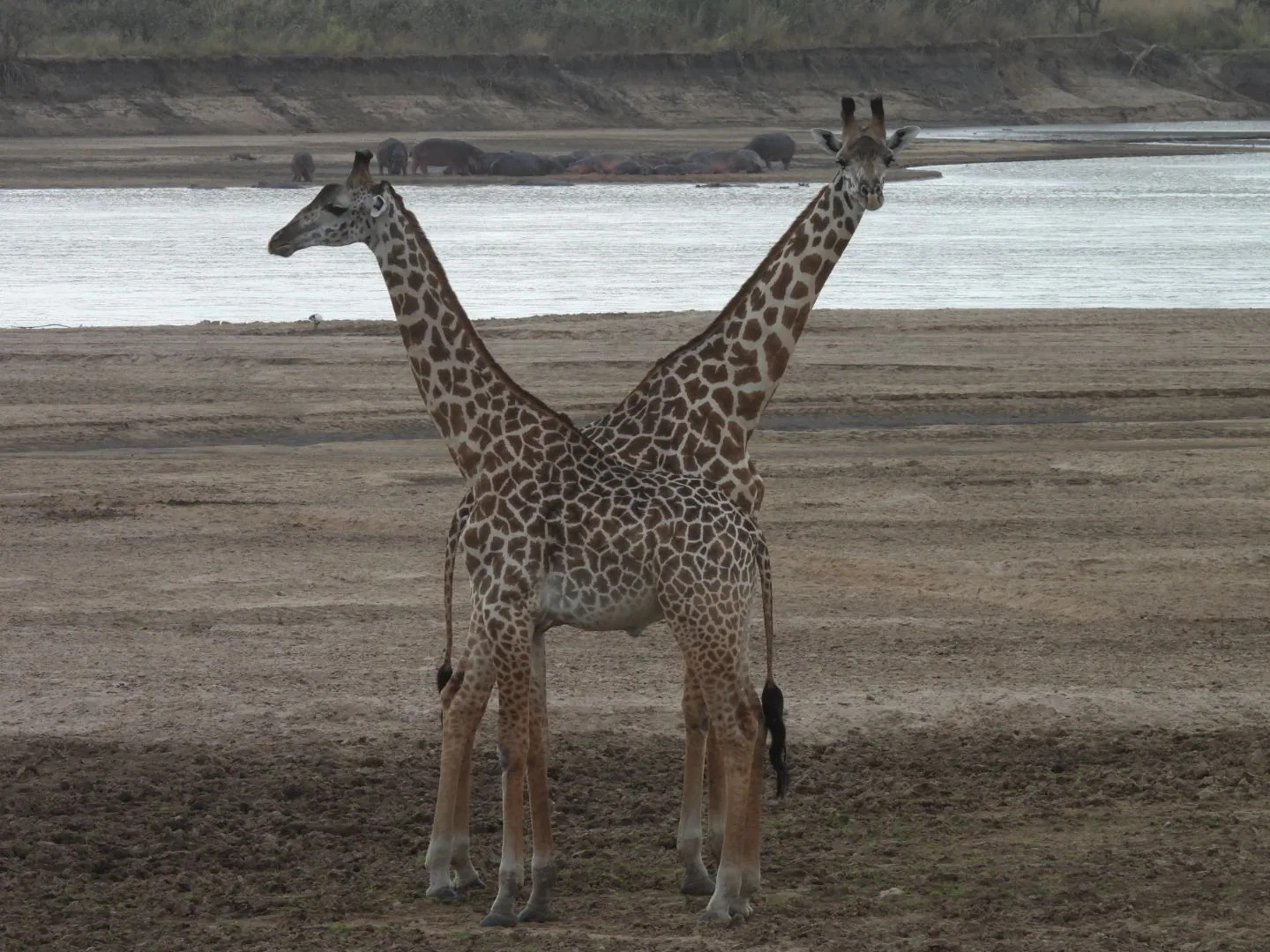
Giraffe family: about 25 million years ago · Earliest Giraffa: about 9 million years ago · Reclassified with the Masai giraffe: 2025
The giraffe family split from other ruminants roughly 25 million years ago; its earliest known member, Canthumeryx, lived in the early Miocene of Libya and Kenya 14. The genus Giraffa goes back at least 9 million years 15.
The Luangwa’s own giraffe has a new scientific name. In August 2025 the IUCN recognized four giraffe species, and Thornicroft’s giraffe is now a subspecies of the Masai giraffe, Giraffa tippelskirchi thornicrofti 16. Genome-wide data show the Luangwa animals form a distinct genetic cluster, and the whole population numbers only 650–890 17. It is evolution by geography in real time: a valley isolated enough to produce a giraffe found nowhere else.
African buffalo Syncerus caffer
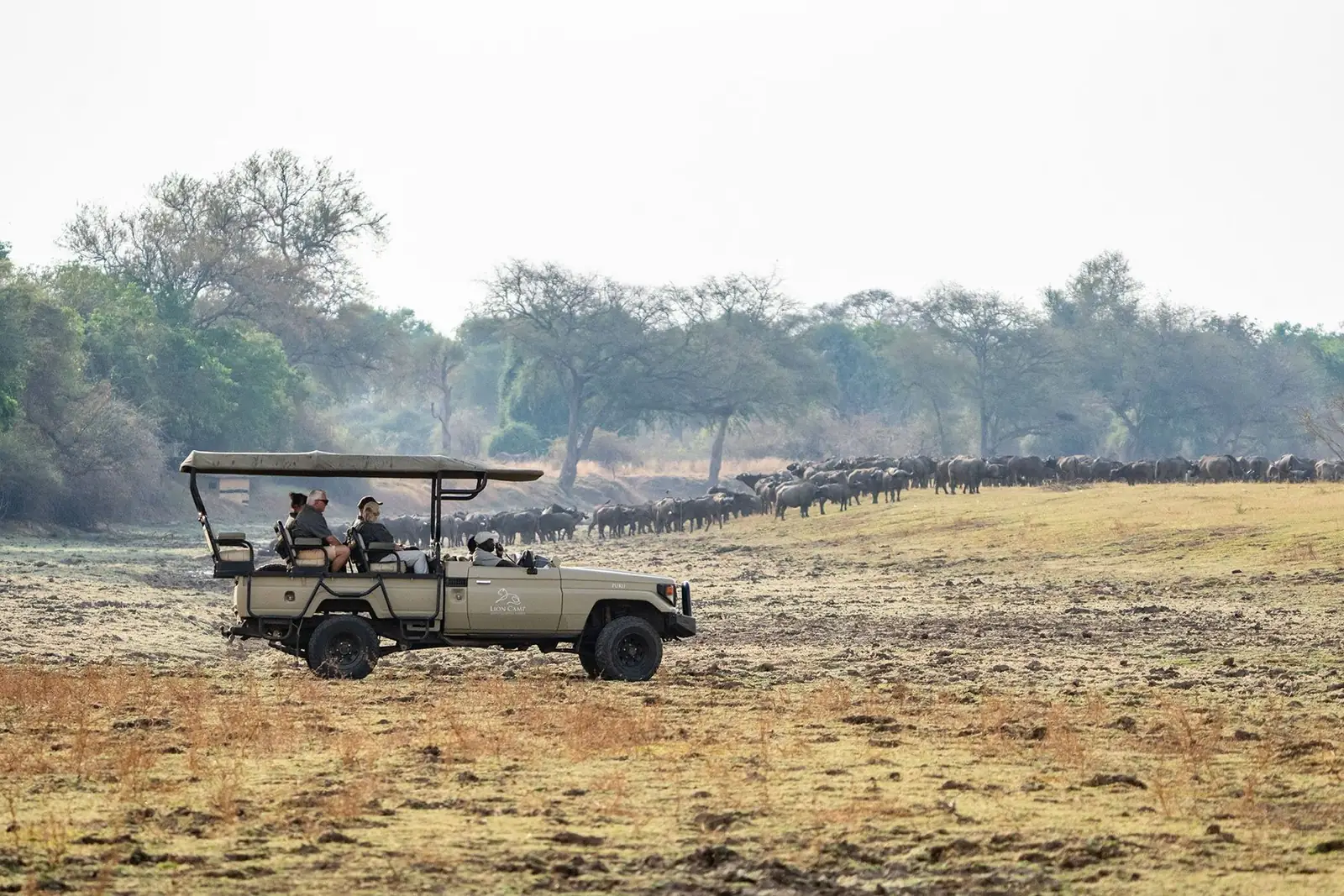
Syncerus acoelotus: about 2.7–1.2 million years ago · Southern (Cape) buffalo: about 150,000 years ago
The buffalo genus Syncerus belongs to the cattle family’s buffalo branch. Its earliest widely accepted member, the extinct Syncerus acoelotus, was first named from Olduvai Gorge, and its fossils may be as old as 2.7 million years. Genetic studies suggest the southern buffalo of the Luangwa, Syncerus caffer caffer, is surprisingly young, arising perhaps 150,000 years ago 18. Where the herds concentrate in the dry season, the lions follow.
Crawshay’s zebra Equus quagga crawshayi
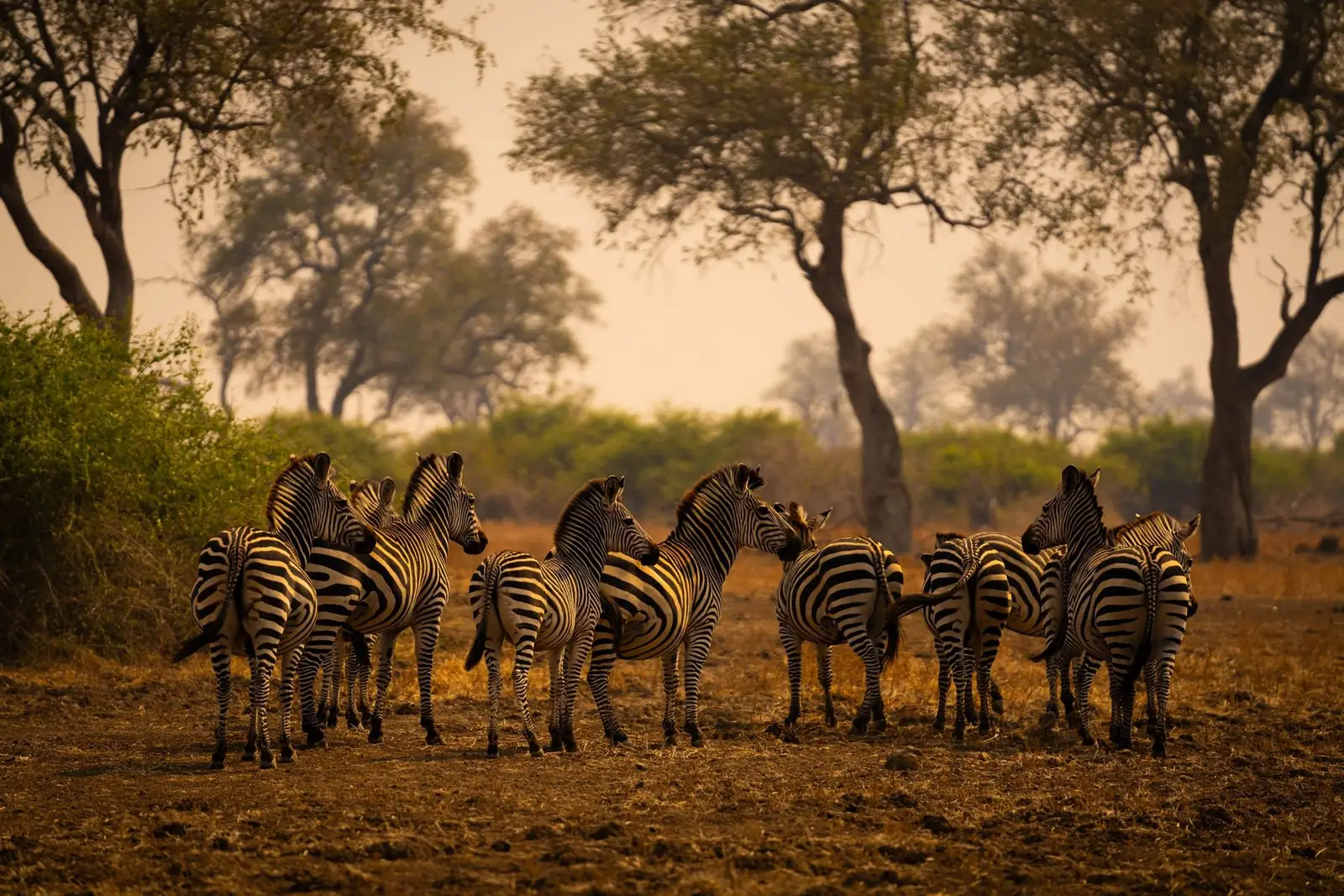
Genus Equus reaches Africa: about 2.3 million years ago · Living plains zebras spread from southern Africa: about 370,000 years ago
Zebras are immigrants. The horse genus Equus evolved in North America, crossed into Eurasia about 2.6 million years ago and first appears in Africa about 2.3 million years ago, as grasslands spread 19. A 2018 genome study traced every living plains zebra to a population in the Zambia–Botswana region that expanded about 370,000 years ago 20. The Luangwa’s narrow-striped zebras are usually called Crawshay’s zebra 21, though the same study found that the traditional zebra subspecies do not line up neatly with the genetic groups 20.
Greater kudu Tragelaphus strepsiceros
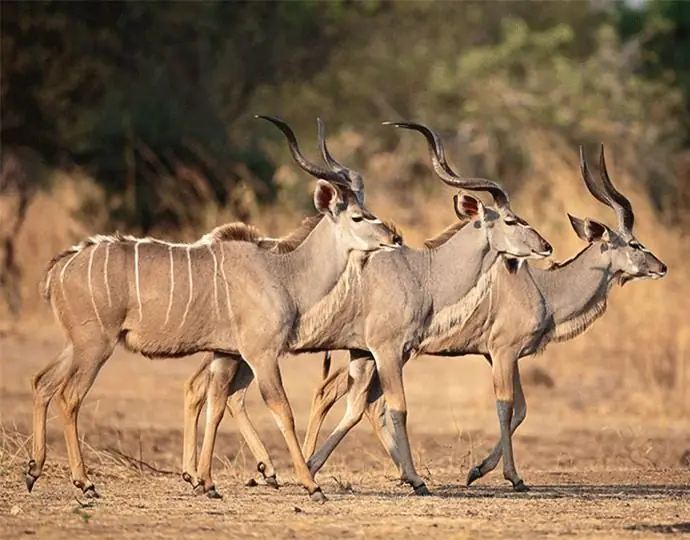
In the East African fossil record: about 2 million years ago
Greater kudu appear in the fossil record of Ethiopia’s Omo basin at about the same time as Homo erectus 22. Today they are the spiral-horned signature of the Luangwa’s mopane and miombo woodland.
Lion Panthera leo
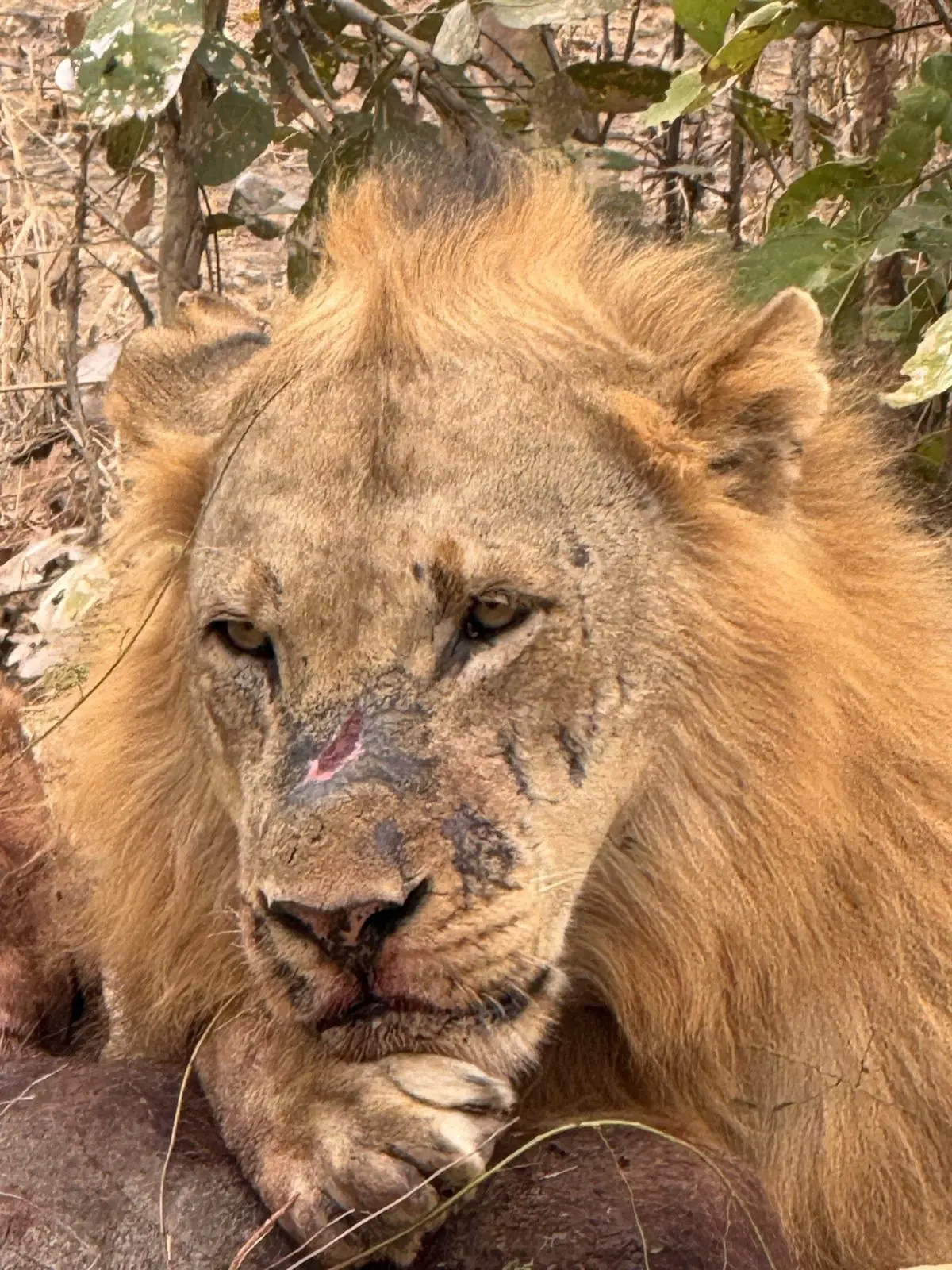
Early big cats in East Africa: about 3.5 million years ago · First true lions: about 1.9–1.7 million years ago
Early big cats were present at Laetoli in Tanzania about 3.5 million years ago 23,24. The first fossils recognizable as true lions come from Olduvai Gorge, about 1.87–1.7 million years old 25. Africa was the lion’s cradle: the giant Ice Age lions of Eurasia, including Panthera fossilis and the cave lion, were offshoots of African lions, not their ancestors 23,25. Lions moved into a system already assembled from water, grass and prey. No buffalo, no lion.
Leopard Panthera pardus
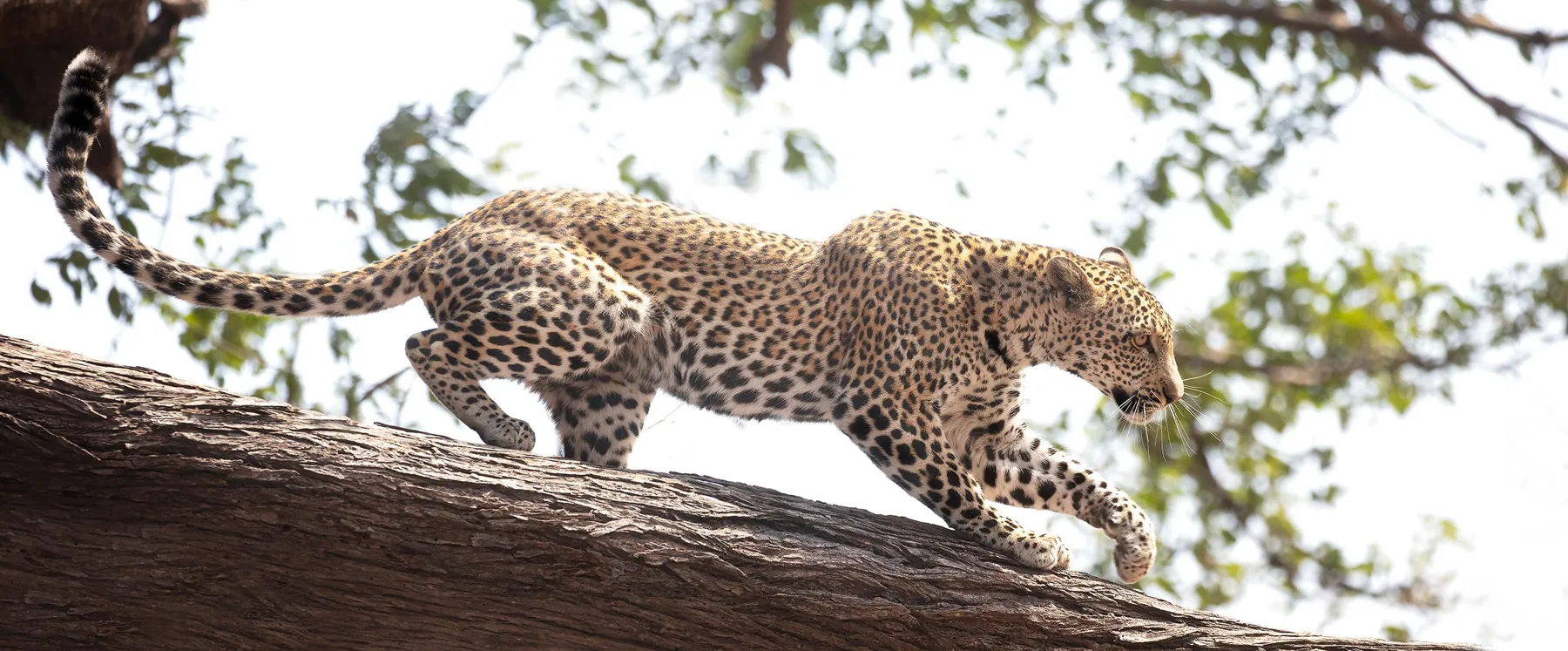
Lion and leopard lines split: about 3.1–1.95 million years ago · Oldest leopard fossils, East Africa: about 2 million years ago · Asian leopards leave Africa: about 710,000–483,000 years ago
If the Luangwa has a signature predator, it is the leopard, and night drives and walks here are shaped around the chance of seeing one.
Within the big cats, the tiger branched off first, then the jaguar; lion and leopard were the last to part 26, roughly 3.1–1.95 million years ago 27. The lion is the leopard’s closest living relative. Claims of 3.5-million-year-old leopards do not hold up: a 2022 re-examination found that the leopard-sized cat from Laetoli was an early relative of the puma 24.
The leopard itself is African. The oldest leopard fossils come from East Africa, and African leopards carry far more genetic diversity than Asian ones, the signature of a place of origin 28. Leopards reached Asia by about 2 million years ago, yet every living Asian leopard descends from a later wave out of Africa, about 710,000–483,000 years ago 28,29. The leopards that stayed home are the deepest branch of the family.
From their shared ancestor, lion and leopard took opposite routes. The lion became social and a creature of open country. The leopard became solitary and hidden: rosettes that break up its outline in dappled shade, the strength to haul a kill into a tree beyond the reach of lions and hyenas, and a diet flexible enough to take anything from fish to impala. That adaptability gives it the widest range of any wild cat, and the Luangwa’s riverine forest, thickets and dense prey suit it almost perfectly.
African painted dog Lycaon pictus
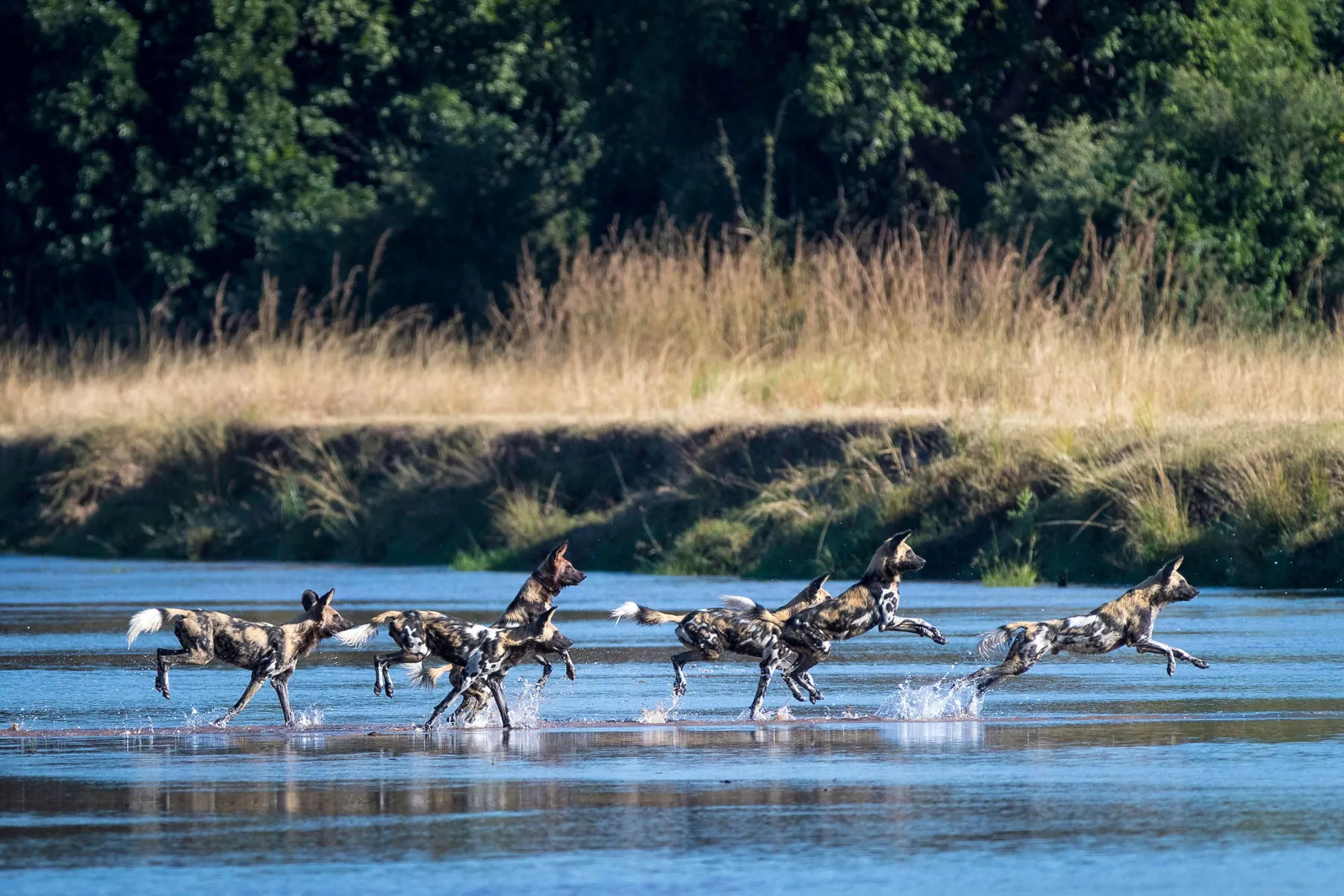
Separates from wolves, jackals and dholes: about 1.7 million years ago · Early hunting dogs in Africa: about 1.8 million years ago · Modern painted dog: after about 770,000 years ago
The painted dog is neither a wolf nor a stray domestic dog. It is the last survivor of its own branch of the dog family. A 2019 genome study dated its separation from wolves, jackals and dholes to about 1.7 million years ago, when its signature traits evolved: four toes on each front foot, meat-shearing teeth and a patchwork coat 30.
Fossils trace a gradual line of hunting dogs from Lycaon lycaonoides, found from Algeria to Japan as early as 1.8 million years ago, to the modern Lycaon pictus of the last 770,000 years or so 31. In southern Africa, Lycaon sekowei, 2–1 million years old, already had the painted dog’s teeth but not its fully running-built front feet 32. If the leopard is evolution’s answer to hunting alone, the painted dog is its answer to hunting together, and the Luangwa is one of the places it can still be watched.
Spotted hyena Crocuta crocuta
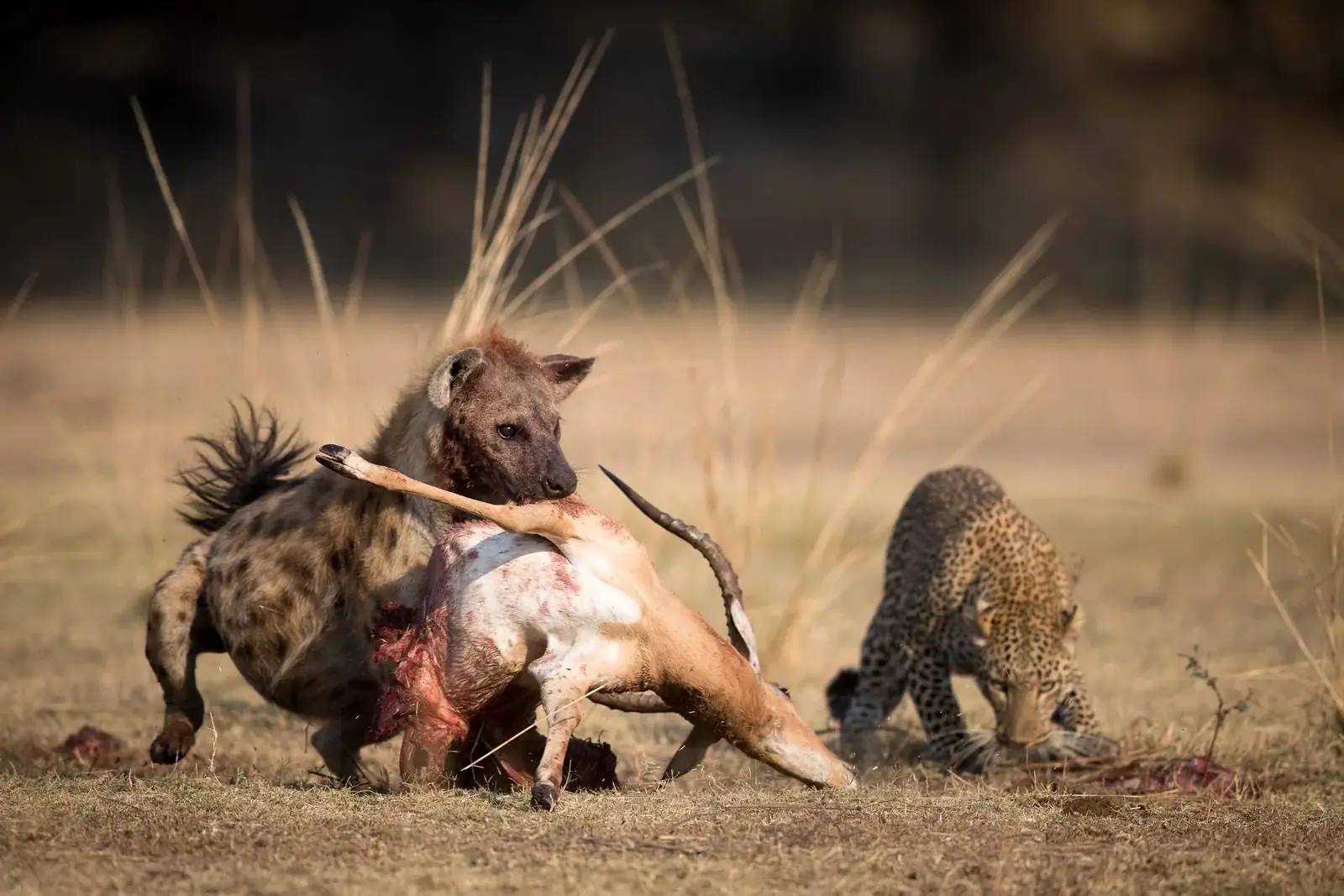
Hyena family: about 22 million years ago, Eurasia · Earliest spotted hyena genus, Africa: 3.85–3.63 million years ago · Oldest spotted hyena: about 2.1 million years ago
Hyenas look and behave like dogs, but they sit on the cat-like side of the carnivore family tree, and their closest living relatives are mongooses 33. The family began in Eurasia about 22 million years ago with small, civet-like animals, and later produced the heavy-jawed bone-crackers that came to dominate scavenging 34.
The earliest fossils of the spotted hyena’s genus, Crocuta, come from Africa, 3.85–3.63 million years ago, and the oldest spotted hyena itself comes from Sterkfontein in South Africa, at least 2.1 million years old 35. Like the lion, it later spread out of Africa: the Ice Age cave hyenas of Europe and Asia were an offshoot of African spotted hyenas 35,36. Far from being only a scavenger, it is a formidable hunter and the lion’s most persistent rival, and its whooping call is as much a part of the Luangwa night as the lion’s roar.
African fish eagle Icthyophaga vocifer
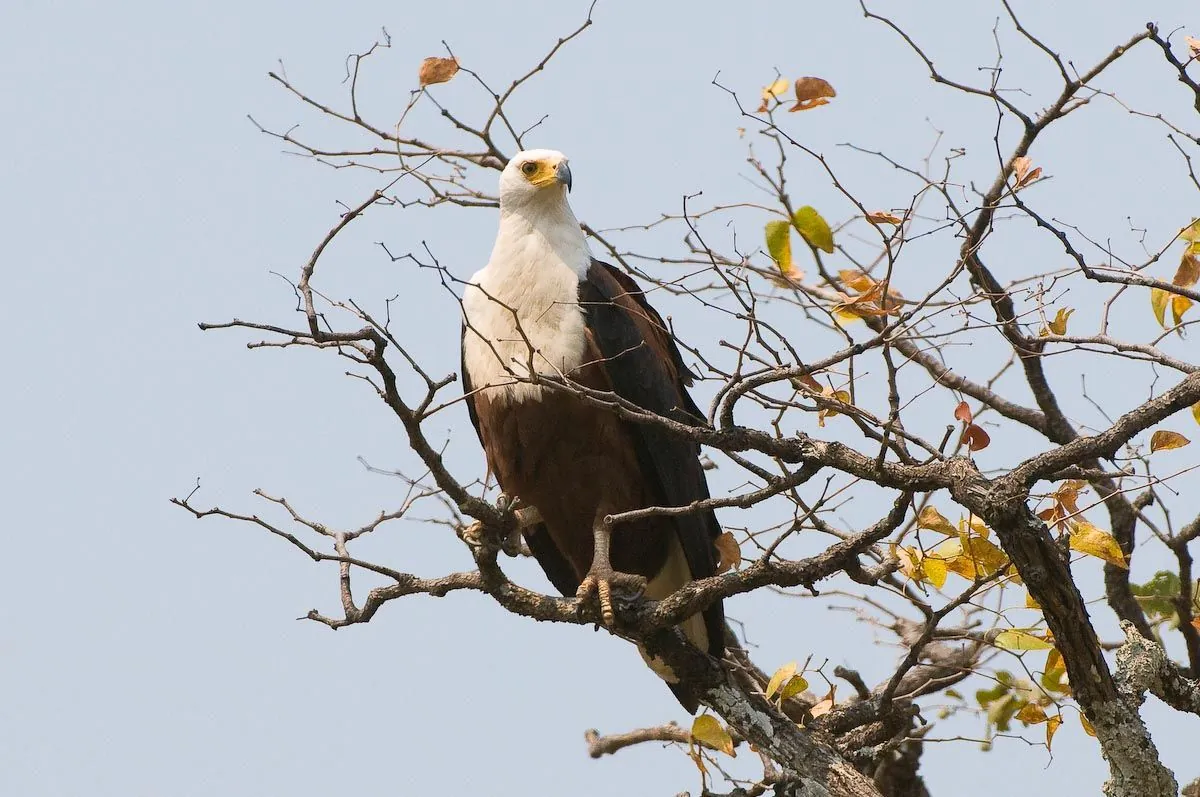
Date of origin unresolved
Zambia’s national bird, long known as Haliaeetus vocifer, was moved in 2023 to the genus Icthyophaga 37. DNA places it closest to the Madagascar fish eagle 38. When the species arose has not been settled, and we would rather say so than invent a number. What is certain is that its call is the sound of the Luangwa River.
III. Wildlife First, Then People
By the Pleistocene, many of the great animal lineages we now associate with the Luangwa, from elephants, hippos and crocodiles to buffalo, giraffes, zebras and the great carnivores, were established across Africa, although some had not yet taken their exact modern form. People came later. When the first toolmakers reached this valley, they walked into an ecosystem that was already running. Archaeologists divide the human story into stages named for the stone tools people made, and the Luangwa has evidence for each of them.
The Early Stone Age: the first toolmakers
In the Luangwa: possibly up to about 1 million years ago
The Early Stone Age is the age of simple flaked cores and, later, big teardrop-shaped hand axes. It lasted from well over 2 million years ago to roughly 300,000 years ago, and its makers were earlier human species. At Manzi, near the Manzi–Luangwa confluence, simple stone cores lie in river gravels whose magnetic record places them within the last million years; the researchers suggest they are no older than about 1 million years 39,2. Hand axes and heavy picks have turned up from the Nchindeni Hills to the Muchinga Escarpment 2.
Riverbanks inside South Luangwa National Park add a remarkable detail. Point bars such as Chowo Beach and Kopje Bar have yielded more than 500 fossils, most of them found by Steve and Anna Tolan, including a human ankle bone. It is too poorly preserved to date, but its shape shows its owner walked upright, much as we do 40.
The Middle Stone Age: our own species
Across Africa: from about 315,000 years ago · In the Luangwa: dated layers about 78,000–40,000 years ago
The Middle Stone Age brought carefully prepared cores for striking off flakes of a planned shape, and it coincides with the appearance of Homo sapiens about 300,000 years ago 2,41. Zambia is central to this story. At Kalambo Falls, two logs deliberately notched together are at least 476,000 years old, the oldest known wooden structure anywhere 42, and the Broken Hill skull from Kabwe is about 299,000 years old 43. In the Luangwa, Middle Stone Age tools at Manzi lie in layers about 78,000 years old 39, tool-bearing gravels in the central valley kept building up until about 77,000 years ago 44, and other layers date to about 70,000–40,000 years ago 40.
The Later Stone Age: the hunter-gatherers
Eastern Zambia: a record reaching back about 37,000 years
The Later Stone Age is the world of the hunter-gatherers most people picture: tiny stone blades set into arrows and knives, bone tools and shell beads. Just east of the valley, Kalemba rock shelter holds about 37,000 years of human use, including the shift to these fine tools 45. Red geometric paintings of circles, ladders and rows of dots along the Luangwa escarpment, including the Nchindeni Hills, are often credited to hunter-gatherers remembered locally as the Batwa, though researchers caution that the link is unproven and few paintings are dated 46. Life followed the river and the seasons: game and water in the dry months, fruits and roots, fish from shrinking lagoons. It was the same rhythm the animals lived by.
The first farmers
First farming village in the Luangwa: about AD 400–700 · Luangwa pottery tradition: by the 11th–12th century AD
Iron came next. Bantu-speaking farming peoples moved into south-central Africa in the first millennium AD, bringing pottery, iron smelting, crops and settled villages. Radiocarbon dates from Chowo, in the valley, put the first farming village here at about AD 400–700 47, and for centuries farmers and hunter-gatherers shared the landscape. By the 11th or 12th century a new pottery style, the Luangwa tradition, had spread across northern and eastern Zambia 48. Chewa-speaking communities say their ancestors made many of the region’s later white rock paintings, used in rites of passage 49.
This is where we must resist a romantic myth. The communities around South Luangwa today have not lived unchanged Stone Age lives. Languages, chiefdoms, trade routes, colonial rule, national parks, roads, schools and tourism have all transformed life in the valley. What has endured is the ecology underneath: the rains still decide when crops go in, fish still follow the rise and fall of the river, and elephants still cross people’s paths. The tools changed. The relationship with the river did not.
How long has the Luangwa been the Luangwa?
The honest answer: at least several hundred thousand years, and possibly close to a million
The riverbank fossils give the clearest answer. They include hippo, elephant, crocodile, buffalo, impala, kudu, warthog, bushpig, zebra, giraffe relatives and wild canids. Most come from sediments laid down within roughly the last 770,000 years, almost all are indistinguishable from species living here now, and together they describe an environment much like today’s, with a slightly different mix of animals 40.
Put that beside the stone tools and the claim this valley can honestly make is this: for at least several hundred thousand years, and possibly close to a million, the Luangwa has been doing what you see it do today. The river floods and shrinks, elephants and hippos work the floodplain, crocodiles wait at the water’s edge, and people have lived and moved through it for much of that time.
Two qualifiers keep that honest. The fossils cannot be dated precisely, because the river washed them out of older deposits. And no lion fossils have yet been found in the valley, so while lions almost certainly lived here, the Luangwa’s own record cannot yet say for how long.
IV. And, Very Recently, the Park
Luangwa Game Park 1904 · South Luangwa Game Reserve 1938 · National park 1972
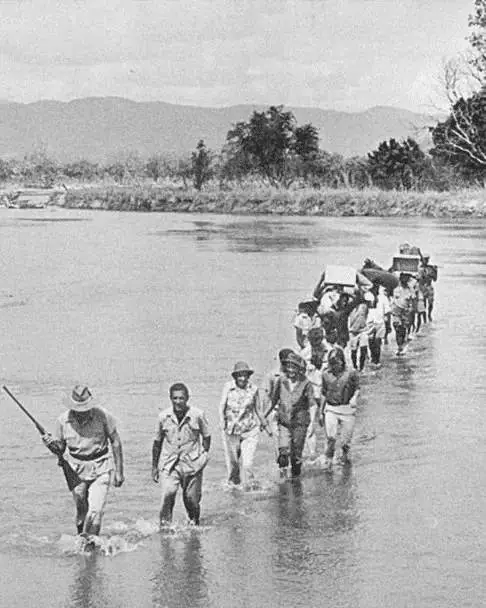
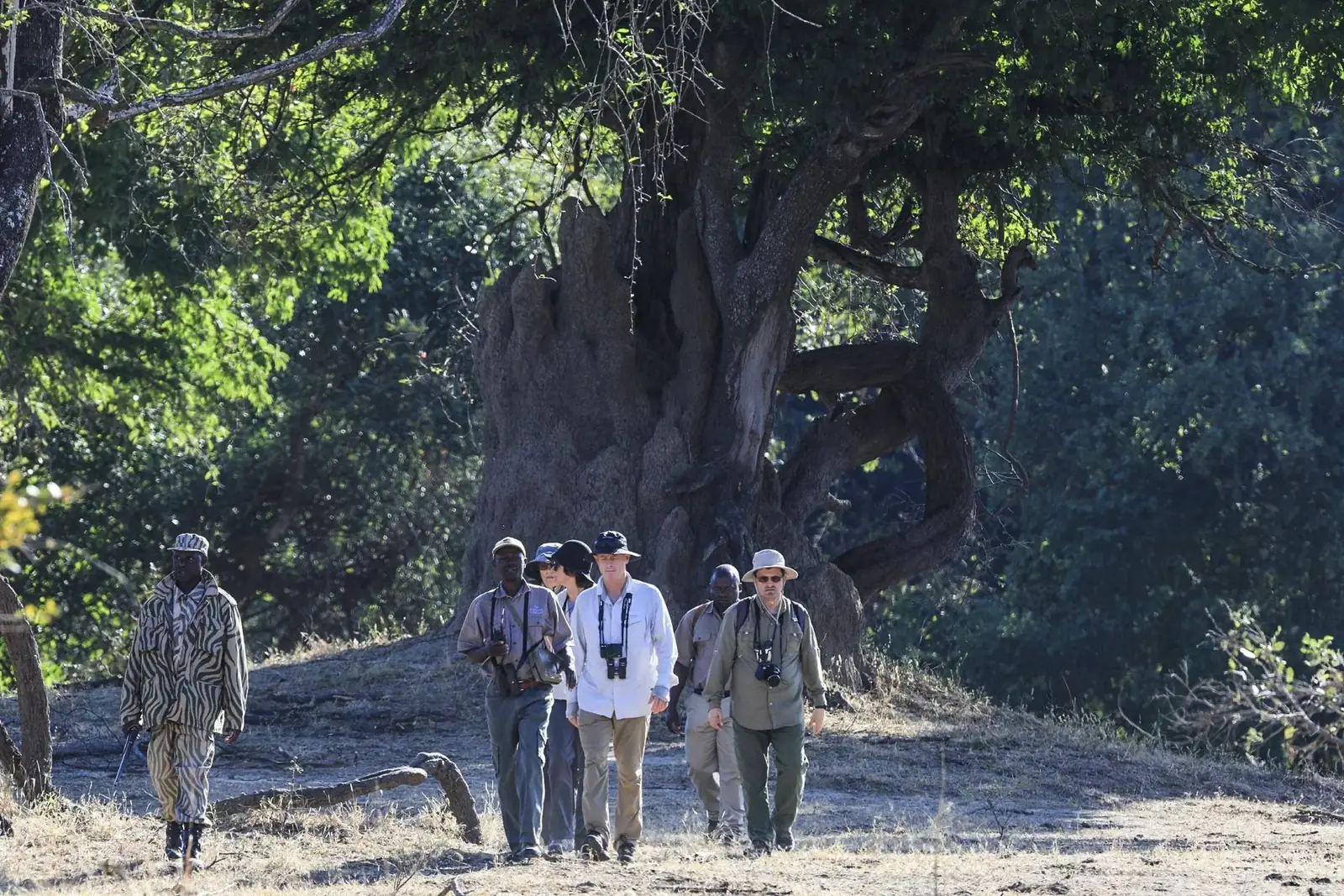
Against this timeline, formal conservation happened yesterday. A Luangwa game park was proclaimed east of the river in 1904; the South Luangwa Game Reserve followed on May 27, 1938, and it became South Luangwa National Park on February 15, 1972 50. Norman Carr joined the reserve as a ranger in 1939 50, and in the early 1960s the Luangwa pioneered the walking safari as a form of tourism around the Chibembe pontoon area 51,52.
But walking through this valley was never new. People had been doing it for hundreds of thousands of years. Only walking through it for pleasure was.
The Whole Story on One Riverbank
Compress it all into a single day and the Luangwa rift opens just after midnight. The Triassic creatures of the Ntawere beds come and go before dawn. Elephants, hippos and giraffes take shape in the last hour. Lions, leopards, hyenas, painted dogs and zebras arrive in the final minutes. Humans appear in the last seconds, and the national park a blink before midnight.
Yet on a single afternoon you can see all of it at once: a crocodile carrying a design more than 200 million years deep; a hippo whose cousins swim in the ocean; an elephant, last of a once-enormous family; a giraffe found in this one valley; a leopard, heir to the oldest branch of its kind; and a guide ahead of you, reading tracks in the sand the way people here have done for a very long time.
The Luangwa is not a place frozen in time. The river moves, species evolve, cultures change. It is simply the latest frame in a film that has been running for a quarter of a billion years, and protecting it means letting that story keep running.
Timeline: the Luangwa in deep time
See the valley that took 245 million years to make.
The wildlife of the valleySources
- Banks, Bardwell et al. (1995), Karoo Rift basins of the Luangwa Valley, Zambia, Geological Society Special Publication 80. https://www.lyellcollection.org/doi/abs/10.1144/GSL.SP.1995.080.01.13
- Bisson et al. (2022), The archaeological potential of the northern Luangwa Valley, Zambia: the Luwumbu basin, PLOS One. https://journals.plos.org/plosone/article?id=10.1371%2Fjournal.pone.0269209
- Peecook et al. (2018), Updated geology and vertebrate paleontology of the Triassic Ntawere Formation of northeastern Zambia, SVP Memoir 17. https://www.tandfonline.com/doi/full/10.1080/02724634.2017.1410484
- Peecook et al. (2013), A new silesaurid from the upper Ntawere Formation of Zambia, Journal of Vertebrate Paleontology. https://www.tandfonline.com/doi/abs/10.1080/02724634.2013.755991
- Hekkala et al. (2021), Paleogenomics illuminates the evolutionary history of the extinct Holocene “horned” crocodile of Madagascar, Voay robustus, Communications Biology. https://www.nature.com/articles/s42003-021-02017-0
- Oaks (2011), A time-calibrated species tree of Crocodylia reveals a recent radiation of the true crocodiles, Evolution. https://academic.oup.com/evolut/article/65/11/3285/6853944
- Delfino et al. (2020), Old African fossils provide new evidence for the origin of the American crocodiles, Scientific Reports. https://www.nature.com/articles/s41598-020-68482-5
- Boisserie, Lihoreau & Brunet (2005), The position of Hippopotamidae within Cetartiodactyla, PNAS. https://www.pnas.org/doi/10.1073/pnas.0409518102
- Kenyapotamus (summary of fossil range). https://en.wikipedia.org/wiki/Kenyapotamus
- Orliac et al. (2010), Early Miocene hippopotamids (Cetartiodactyla) constrain the phylogenetic and spatiotemporal settings of hippopotamid origin, PNAS. https://www.pnas.org/doi/10.1073/pnas.1001373107
- Gheerbrant (2009), Paleocene emergence of elephant relatives and the rapid radiation of African ungulates, PNAS. https://www.pnas.org/doi/10.1073/pnas.0900251106
- African elephant (summary of Loxodonta fossil record). https://en.wikipedia.org/wiki/African_elephant
- Rohland et al. (2010), Genomic DNA sequences from mastodon and woolly mammoth reveal deep speciation of forest and savanna elephants, PLOS Biology. https://journals.plos.org/plosbiology/article?id=10.1371%2Fjournal.pbio.1000564
- Fossil focus: Giraffidae, Palaeontology Online. https://www.palaeontologyonline.com/?p=3916
- Danowitz et al. (2017), The earliest ossicone and post-cranial record of Giraffa, PLOS One. https://www.ncbi.nlm.nih.gov/pmc/articles/PMC5605118/
- IUCN (August 21, 2025), Four giraffe species officially recognised in major conservation reclassification. https://iucn.org/press-release/202508/four-giraffe-species-officially-recognised-major-conservation-reclassification
- IUCN SSC Giraffe and Okapi Specialist Group Taxonomic Task Force (2025), An Evaluation of the Taxonomic Status of Giraffe. https://iucn.org/sites/default/files/2025-08/gosgtaxonomictask-force_iucn_giraffetaxonomyassessment_final.pdf
- The Evolutionary History of the African Buffalo, in Ecology and Management of the African Buffalo (Cambridge University Press). https://www.cambridge.org/core/books/ecology-and-management-of-the-african-buffalo/evolutionary-history-of-the-african-buffalo-is-it-truly-a-bovine/D03B5647BEFD14A59271453741A2A6AB
- Bernor et al. (2019), Evolution of Early Equus in Italy, Georgia, the Indian Subcontinent, East Africa, and the Origins of African Zebras, Frontiers in Ecology and Evolution. https://www.frontiersin.org/journals/ecology-and-evolution/articles/10.3389/fevo.2019.00166/full
- Pedersen et al. (2018), A southern African origin and cryptic structure in the highly mobile plains zebra, Nature Ecology & Evolution. https://www.nature.com/articles/s41559-017-0453-7
- Crawshay’s zebra (range summary, citing IUCN Red List 2016). https://en.wikipedia.org/wiki/Crawshay's_zebra
- Bobe & Leakey (2009), Ecology of Plio-Pleistocene Mammals in the Omo-Turkana Basin and the Emergence of Homo. https://www.researchgate.net/publication/226400260_Ecology_of_Plio-Pleistocene_Mammals_in_the_Omo-Turkana_Basin_and_the_Emergence_of_Homo
- Barnett et al. (2016), Mitogenomics of the extinct cave lion, Panthera spelaea, Open Quaternary. https://openquaternary.com/articles/10.5334/oq.24
- Hemmer (2022), The identity of the “lion”, Panthera principialis sp. nov., from the Pliocene Tanzanian site of Laetoli, Palaeobiodiversity and Palaeoenvironments. https://link.springer.com/article/10.1007/s12549-022-00542-2
- About the origin and environment of Panthera spelaea (2024), ScienceDirect. https://www.sciencedirect.com/science/article/pii/S2950475924000108
- Pantherinae (summary of branching order and divergence dates). https://en.wikipedia.org/wiki/Pantherinae
- Davis, Li & Murphy (2010), Supermatrix and species tree methods resolve phylogenetic relationships within the big cats, Panthera, Molecular Phylogenetics and Evolution. https://www.sciencedirect.com/science/article/abs/pii/S1055790310000473
- Paijmans et al. (2018), Historical biogeography of the leopard (Panthera pardus) and its extinct Eurasian populations, BMC Evolutionary Biology. https://link.springer.com/article/10.1186/s12862-018-1268-0
- Morris et al. (2024), Unravelling the maternal evolutionary history of the African leopard, PeerJ. https://peerj.com/articles/17018.pdf
- Chavez et al. (2019), Comparative genomics provides new insights into the remarkable adaptations of the African wild dog (Lycaon pictus), Scientific Reports. https://www.nature.com/articles/s41598-019-44772-5
- Martínez-Navarro & Rook (2003), Gradual evolution in the African hunting dog lineage: systematic implications, Comptes Rendus Palevol. https://www.sciencedirect.com/science/article/pii/S1631068303001155
- Hartstone-Rose et al. (2010), The Plio-Pleistocene ancestor of wild dogs, Lycaon sekowei n. sp., Journal of Paleontology. https://www.researchgate.net/publication/228515255_The_Plio-Pleistocene_Ancestor_of_Wild_Dogs_Lycaon_sekowei_n_sp
- Koepfli et al. (2006), Molecular systematics of the Hyaenidae: relationships of a relictual lineage resolved by a molecular supermatrix, Molecular Phylogenetics and Evolution. https://www.sciencedirect.com/science/article/abs/pii/S1055790305003623
- Hyena (summary of family origins). https://en.wikipedia.org/wiki/Hyena
- Spotted hyena (summary of fossil record). https://en.wikipedia.org/wiki/Spotted_hyena
- Westbury et al. (2020), Hyena paleogenomes reveal a complex evolutionary history of cross-continental gene flow between spotted and cave hyena, Science Advances. https://www.science.org/doi/10.1126/sciadv.aay0456
- Avibase: Icthyophaga vocifer (African Fish Eagle), current IOC taxonomy. https://avibase.bsc-eoc.org/species.jsp?avibaseid=A19B0CF4A0D54658
- Lerner & Mindell (2005), Phylogeny of eagles, Old World vultures, and other Accipitridae based on nuclear and mitochondrial DNA, Molecular Phylogenetics and Evolution. https://www.researchgate.net/publication/7815523_Phylogeny_of_eagles_Old_World_vultures_and_other_Accipitridae_based_on_nuclear_and_mitochondrial_DNA
- Barham et al. (2011), The dating and interpretation of a Mode 1 site in the Luangwa Valley, Zambia, Journal of Human Evolution. https://www.sciencedirect.com/science/article/abs/pii/S0047248410002393
- Bishop et al. (2016), Quaternary fossil fauna from the Luangwa Valley, Zambia, Journal of Quaternary Science. https://onlinelibrary.wiley.com/doi/full/10.1002/jqs.2855
- Smithsonian Human Origins Program, Oldest wooden structures almost 500,000 years old. https://humanorigins.si.edu/research/whats-hot-human-origins/oldest-wooden-structures-almost-500000-years-old
- Barham et al. (2023), Evidence for the earliest structural use of wood at least 476,000 years ago, Nature. https://www.nature.com/articles/s41586-023-06557-9
- Grün et al. (2020), Dating the skull from Broken Hill, Zambia, and its position in human evolution, Nature. https://www.nature.com/articles/s41586-020-2165-4
- New geomorphological and archaeological evidence for drainage evolution in the Luangwa Valley (Zambia) during the Late Pleistocene (2021), Geomorphology. https://www.sciencedirect.com/science/article/abs/pii/S0169555X21003317
- Kalemba Rockshelter (summary of D. W. Phillipson’s 1971 excavation). https://en.wikipedia.org/wiki/Kalemba_Rockshelter
- Olivier (2011), Geometric rock art along the Luangwa Valley escarpment, Zambia, and its relationship with the Later Stone Age (DPhil thesis, University of Oxford). https://www.academia.edu/1279879/Geometric_rock_art_along_the_Luangwa_Valley_escarpment_Zambia_and_its_relationship_with_the_Later_Stone_Age_in_southern_and_south_central_Africa
- New Radiocarbon Dates for the Early Iron Age in the Luangwa Valley, Eastern Zambia. https://www.academia.edu/1448519/New_Radiocarbon_Dates_for_the_Early_Iron_Age_in_the_Luangwa_Valley_Eastern_Zambia
- Phillipson, Iron Age History and Archaeology in Zambia, Journal of African History. https://www.cambridge.org/core/journals/journal-of-african-history/article/abs/iron-age-history-and-archaeology-in-zambia/1250748A51D2329408DD13760AD7F573
- British Museum African Rock Art Image Project, Introduction to rock art in central and eastern Africa. https://africanrockart.britishmuseum.org/regional_introduction/rock-art-in-central-and-east-africa/
- The Bushcamp Company, Overview and History of South Luangwa National Park. https://bushcampcompany.com/blogs/south-luangwa/overview-and-history-of-south-luangwa-national-park
- Chibembe Wildlife Reserve, History. https://www.chibembewildlifereserve.com/history
- National Geographic (2024), What it’s like to trek through South Luangwa National Park in Zambia. https://www.nationalgeographic.com/travel/article/walking-safari-south-luangwa-zambia-valley-of-the-leopard