Safari is a Swahili word, and it does not mean “luxury lodge.” It means journey. For most of the history of African travel, that is exactly what a safari was — a line of movement through wild country, sleeping where the day ended, waking somewhere new. Somewhere along the way the industry quietly redefined the word to mean a building: a single address you fly into, settle at, and drive out from each morning, returning each night to the same bed, the same bar, the same stretch of river. Comfortable. Convenient. And a fundamental misunderstanding of what makes the experience extraordinary.
A safari was always meant to be a circuit — a route through a landscape, not a residence within it. The case for traveling that way is not nostalgia. It is the difference between seeing a place and knowing one.
One address shows you one neighborhood. A circuit shows you the whole valley.
A National Park Is Not One Place
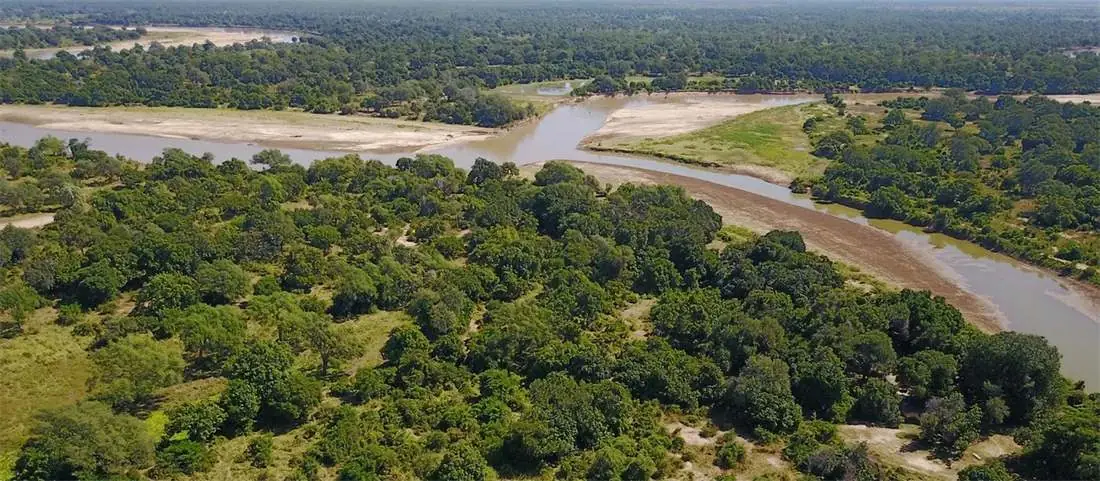
South Luangwa is roughly the size of a small country, and it is not a single environment. It is a mosaic — ebony groves and riverine forest along the main channel; open floodplain that fills and empties with the season; oxbow lagoons left behind as the river changes its mind; mopane woodland; dry sand rivers that cut through the interior. Each of these supports a different cast. Leopard hunt the dense riverine cover. Painted dog run the open ground. Elephant move to the fruiting trees. The carmine bee-eaters nest in the river banks for a few weeks and then are gone.
A lodge sits in one of these environments. Its morning drives reach a radius of maybe twenty or thirty minutes’ driving before they have to turn back to be home for brunch. Stay a week and you will come to know that radius intimately — the same loop, the same lagoon, the same pride. It is a beautiful neighborhood. But it is a neighborhood, and the park is a continent of them.
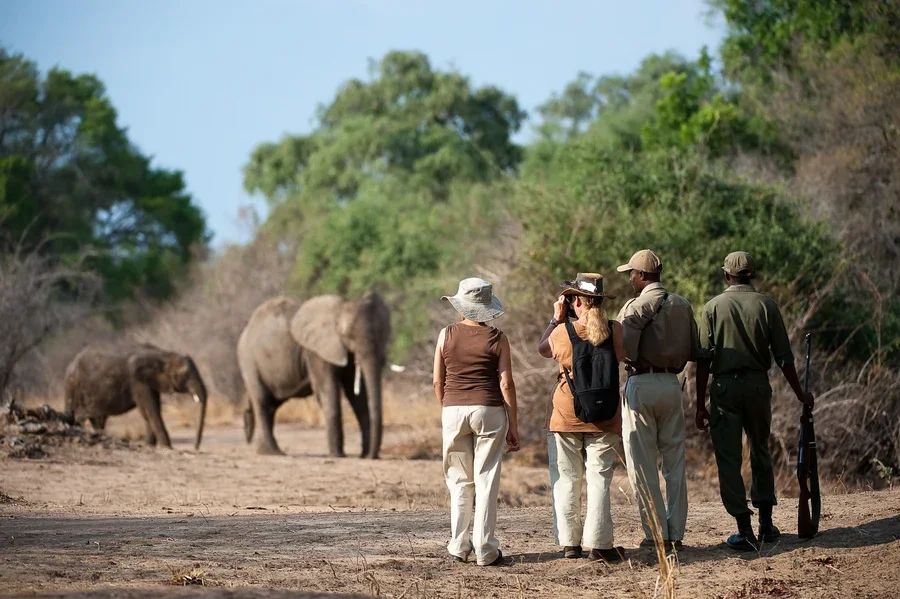
Move through the park instead, and the wildlife changes under you as the country does. You begin in the busy, fertile heart near the river. You walk out into the quiet interior where few vehicles ever go. You end somewhere remote enough that the only lights at night are your own. Each camp is positioned for its own ground, and the sequence of them is the safari. You are not returning to a base. You are advancing through a story the landscape is telling in order.
Resident Wildlife, Read Across the Season
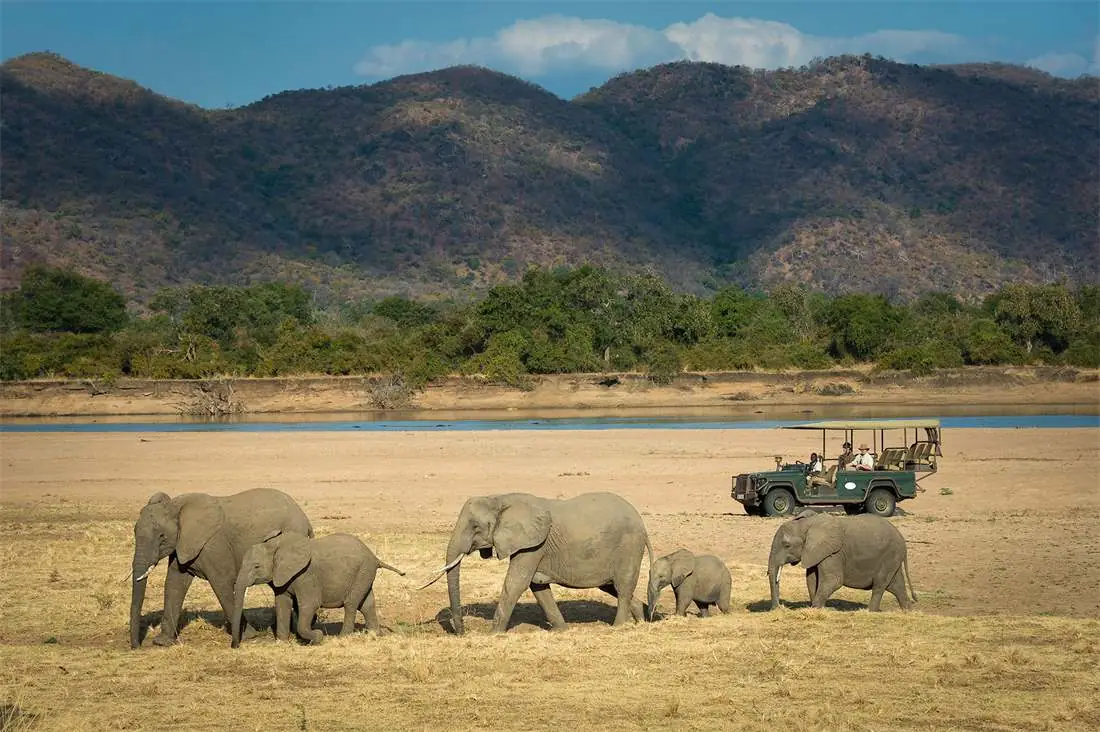
It is worth being clear about what South Luangwa is, because it is not the Serengeti. There is no great migration here, no herd to chase across a frontier. The Luangwa is a resident valley — its elephant, buffalo, leopard, lion and painted dog live here all year, in known territories, along a single life-giving river. What changes is not where the animals have gone, but how the river gathers them. As the dry season tightens from June to October, the bush thins, the seasonal pans empty, and wildlife draws steadily toward the permanent water — the main channel, the oxbow lagoons, the last green bends. The game does not move away. It concentrates.
This is why a circuit matters here in a way it never could on a migration route. You are not racing to stay ahead of a herd. You are reading one fixed, extraordinarily dense ecosystem from several vantage points at once — a river camp where two hundred hippo crowd a single bend, a lagoon camp where the leopards hold the riverine thickets, an interior camp where the dry sand rivers cut through mopane. Each camp opens a different chapter of the same resident population. A single lodge reads one chapter, beautifully, all week. The circuit reads the book.
And because these are resident animals, the guiding compounds. The walking tradition exists here precisely because the wildlife stays — guides come to know individual prides, individual leopards, the territories and the histories, across seasons and across decades. That depth is the real product. Add that the camps are small and far apart and you have the rare thing too: in the deep bushcamp country you can go days seeing more elephant than vehicles. The solitude is not a marketing line; it is the geometry of a true circuit, where distance between camps means distance between guests.
Inside the Park, Not at the Gate
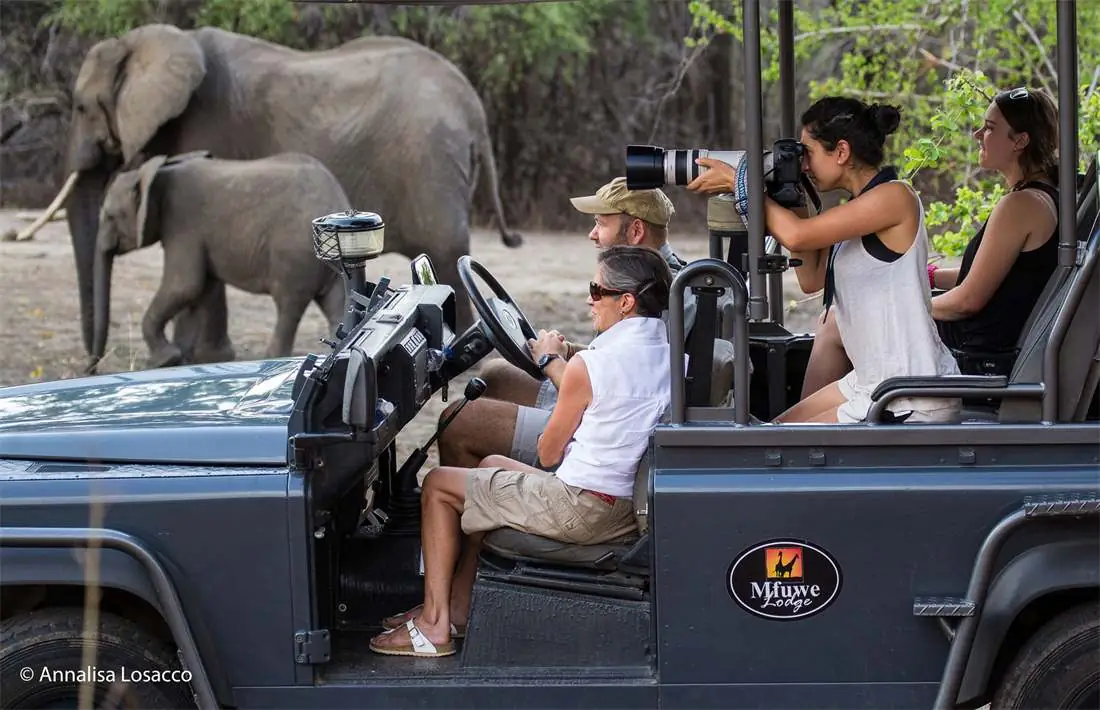
There is a second distinction that matters as much as movement: where the camps actually sit. A great many lodges cluster just outside the park boundary, near the main gate, because it is cheaper to build and easier to supply on private land. Guests there spend the first and best hour of every game drive — the cool, active edge of dawn — driving to the wildlife, and the last golden hour driving back out before the gate closes.
Camps built inside the national park remove the commute entirely. The wilderness begins at the edge of camp. The first light of the morning is spent in the game, not en route to it. And because night has its own rules inside the park, you can stay out for it — the leopard hunt, the lion moving off to work, the genet and the porcupine that the daytime never shows you. A circuit of camps inside the park is not a more scenic version of the same safari. It is a categorically different access to the place.
The Walking Dimension
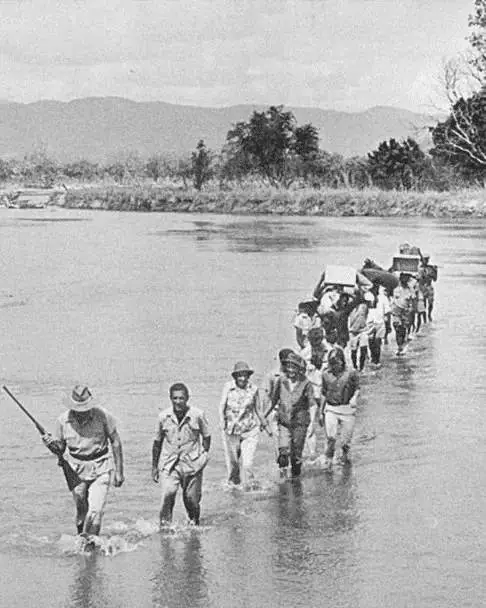
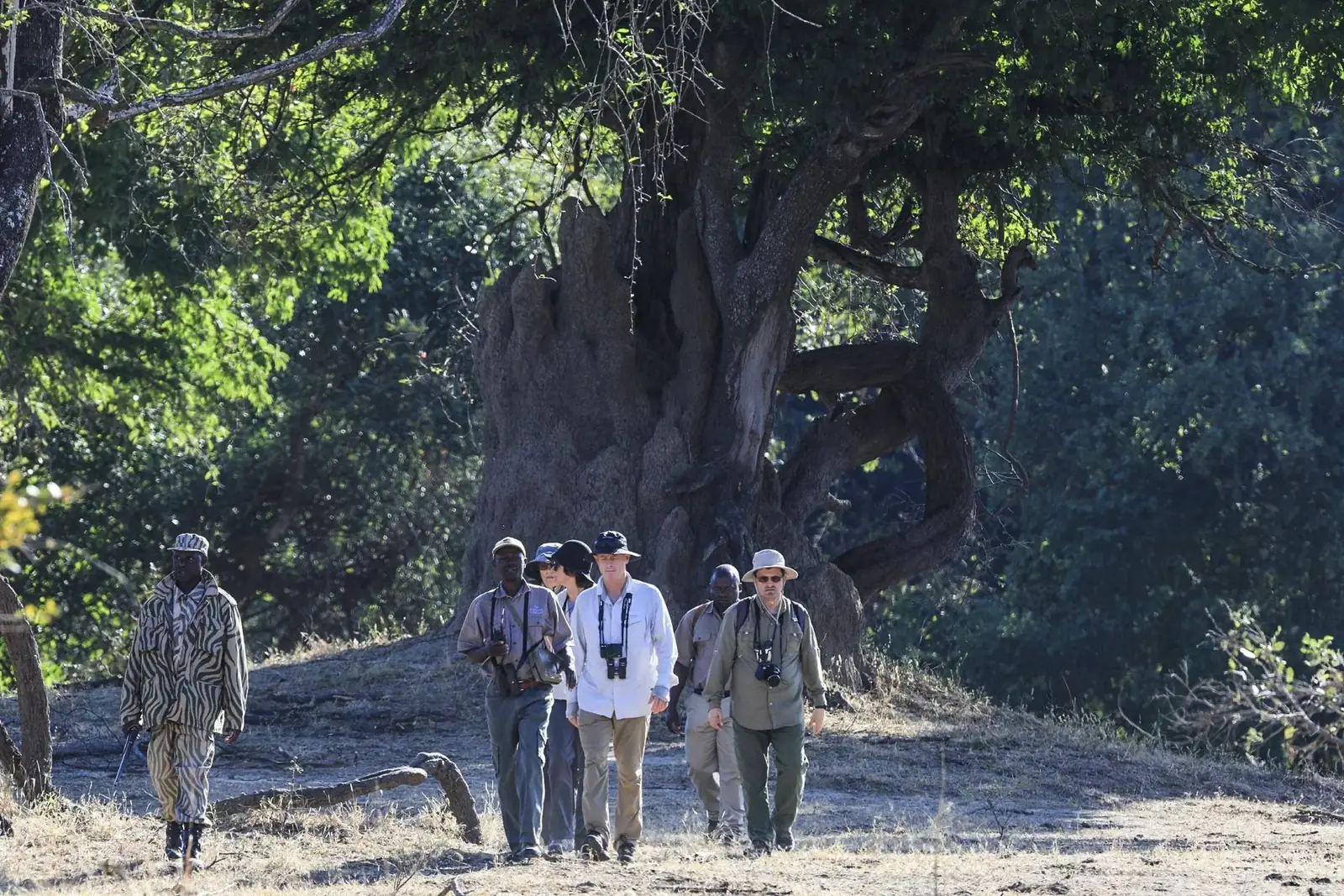
South Luangwa is where the walking safari began, and the circuit is the reason walking works here at all. A bush walk bolted onto a lodge stay is a pleasant hour with a rifle and a checklist. A walking circuit is something else: you walk between camps, covering real ground, reading the country at the pace it was meant to be read. The wind on your neck. The track pressed into the sand an hour ago, or a minute ago. The impala’s alarm call that tells you what is moving before you ever see it. None of this reaches you through a windshield.
This is not a feature we added. It is the founding insight of the form — that you do not truly know a place until you have walked through it, and that the deepest safari is one traveled on foot, in sequence, across the same ground the wildlife uses. The guiding culture that proves it has been concentrated in this valley for seventy years. The form spread across Africa; the substance — the depth of guiding, the literacy of terrain — largely stayed where it was forged.
A vehicle takes you to the wildlife. On foot, through the valley, the wildlife takes you in.
The Transition Is the Safari
Here is something many first-time planners only discover once they are there: they open a map, pick three or four famous lodges owned by entirely different companies, and string them into an ambitious cross-country itinerary. It looks spectacular on paper. In practice it introduces the one thing you came to Africa to escape — friction. Moving between unrelated properties means a logistical shutdown: bags packed at first light, a checkout, a wait at a dusty airstrip, an hour spent flying over the wilderness instead of being in it. The travel day is a write-off, and you have paid handsomely for it.
On a single-operator circuit the move is the safari — usually the best game activity of the trip. When it is time to move on, you do not board a plane. Between the four southern bushcamps you can shoulder a daypack and walk; elsewhere the move is an unhurried game drive, tracking leopard and reading the ground with your guide, while the camp team carries your luggage ahead by road. You arrive at the next camp in time for lunch, having spent the entire “transfer” immersed in the bush. Nothing is lost to logistics, because the logistics happen out of sight. Skipping inter-camp bush flights, with their strict luggage limits, puts more of the trip into guiding and exclusive ground, and less into aviation.
One Team, One Continuous Story
Wildlife ignores property lines, and your guiding should too. Hop between unrelated lodges and every new guide begins from zero — the first hours of each stay spent asking what you have already seen, gauging what you care about, learning how you like to shoot. The narrative resets four times.
A single operator carries the thread. The camps share radios and briefings behind the scenes, so the team at tomorrow’s camp already knows you spent yesterday with the river pride — and can deliberately steer your next outing toward a different world, an oxbow lagoon or a dry sand river, to show you a side of the ecosystem you have not yet met instead of repeating yesterday’s sightings. Your safari becomes one unfolding story, handed forward camp to camp, rather than four disconnected vacations booked back to back.
One Standard, Gateway to Last Camp
Every safari company has its own personality — its own kitchen, its own safety culture, its own benchmark for guiding. Move between operators and the standard shifts from one stay to the next, so a brilliant stay can make the next one’s differences obvious. A single-operator loop lays an unbroken blanket of consistency over the whole journey. The hospitality, the food, and above all the rigor of the guiding stay identical from the largest gateway lodge to the most remote, solar-lit bushcamp.
That uniformity is not only a comfort; on a walking safari it is a single safety standard. The same protocols, the same caliber of armed, park-licensed guide, the same hard-won knowledge of the ground — at the first camp and the last, on foot and in the vehicle, you are always in the hands of one team trained to one standard. Across different operators, every stay starts again with a new team, new protocols and a guide who has not yet seen you walk.
A Safari Should Have an Arc
There is a quieter argument, and it may be the most important one. A great journey has a shape — a beginning, a middle, and an end that means something because of everything before it. The single-lodge safari is, structurally, the same day repeated: arrive, settle, loop, depart. Lovely, but flat. It has no second act.
A circuit has an arc. You begin at a gateway, comfortable and oriented, easing into the rhythm of the bush. You move deeper, into smaller and more remote camps, as your eye sharpens and the valley opens up. And you arrive, finally, somewhere that means something — the wildest ground, or in our case the founding ground itself. By the time you get there you have earned it; you understand what you are looking at. The last camp lands differently because of the first. That is what a journey is, and it is the one thing a building can never give you.
What the complete circuit looks like
The Safari Heritage Collection holds the largest and most classic safari circuit in South Luangwa — ten camps on a continuous circuit through the heart of South Luangwa — sixty miles, camp to camp, all inside or against the park, and beyond the two gateway lodges, well away from the gate. It begins at the gateway lodges at Mfuwe and KuKaya, runs through 140,000 exclusive acres of the southern sector and its remote bushcamps, continues north to Lion Camp, and ends at the documented birthplace of the walking safari at Chibembe, on the east bank of the Luangwa.
One unbroken journey, from the gateway to the origin ground. There is nothing else like it in South Luangwa, because no one else holds the whole circuit.
See the camps of the circuit →The Airplane Test
Many high-end safaris are sold as multi-camp itineraries: three nights here, three nights there, often across two or three countries. It sounds like a grand journey. Mechanically, it usually is not. Each leg is a separate stay, joined to the next by a light aircraft. You land, you are driven to camp, you settle in, and a few days later you are driven back to the airstrip and flown somewhere else to begin again.
There is nothing wrong with that. Some of the finest camps on earth can only be reached by air. But it is a collection of destinations, not a journey. The country between the camps is something you fly over, not something you travel through.
The test is simple. Take away the airplanes. Does the safari still hold together as one journey? For most multi-camp itineraries it does not: remove the flights and you are left with separate stays in separate regions. For a true ground circuit it does, because the ground journey was the point all along.
Very few safaris pass, because four things have to line up at once:
- One continuous wilderness. The camps must sit in one connected piece of wild country, close enough to link on foot and by road, far enough apart to feel distinct.
- One family of camps. Guiding, safety, food and standards have to carry unbroken from the first camp to the last.
- Real walking country. The park has to allow serious walking safaris, which depends on terrain, law and a guiding culture built over decades.
- Room to be alone. There has to be enough exclusive ground that the journey between camps stays wild rather than crossing other companies’ traffic.
The Heritage Circuit passes all four. It begins at the gateway lodges, Mfuwe Lodge and The Villas at KuKaya, runs south through six bushcamps in 140,000 exclusive acres, then north to Lion Camp and across the river to Chibembe. It is a continuous safari circuit through the heart of South Luangwa: sixty miles, camp to camp, in the valley where the walking safari began. Every move between camps is a walk, a game drive or a river crossing. Nobody boards a plane.
How to Judge a Circuit for Yourself
If the completeness of the journey matters more to you than the size of any one suite, a few plain questions separate a true circuit from a collection of stays:
- Are the camps in one continuous wilderness, or scattered across regions and joined by flights?
- Can you travel between them on the ground, on foot and by vehicle, as part of the safari?
- Is it one family of camps throughout, so that guiding and standards carry from camp to camp?
- Does the country genuinely support walking safaris, or is walking a token add-on to a drive?
- Does the experience hold up away from the flagship, or does the best of the trip end at the gate?
Ask those questions of any itinerary. They are the reason this one was built.
The Convenient Choice and the Right One
None of this is an argument against comfort. The best circuits are more comfortable than people expect — the camps are small and beautifully run, the food is real, the beds are good. The point is that comfort was never the question. The question is whether you want to see a park or to travel through one; to visit the wildlife or to live among it for a while; to repeat a single good day or to take a journey that builds.
Safari means journey. The valley where the walking safari began is still one of the finest places on earth to take one the way it was meant to be taken — on the move, on foot, from the gateway to the ground where it all began.
Don’t stay in South Luangwa. Travel through it.
Either of our reservations teams can arrange the complete circuit.
Begin the conversationAbout the Safari Heritage Collection
The Safari Heritage Collection operates the largest and most classic safari circuit in South Luangwa — ten camps on a continuous circuit through the heart of South Luangwa — sixty miles, camp to camp, from the gateway lodges at Mfuwe and KuKaya to Lion Camp in the northern sector and the documented birthplace of the walking safari at Chibembe. The Bushcamp Company has operated camps inside the national park since 1999. Inquiries through either reservations team.
safariheritagecollection.com · Chibembe · The Bushcamp Company · Lion Camp · Where the walking safari began